What makes a rug a true designer rug
A designer rug is a textile work born from a project: an original drawing, a carefully studied color palette and an artisanal weaving process that make it a one-of-a-kind piece, designed to converse with the architecture of the space that hosts it.
This is the substantial difference from a mass-produced rug. As you may well know, an industrial product replicates a pattern endlessly. A designer piece, by contrast, comes from a creative journey: a designer studies trends, chooses the geometries or organic motifs, defines the shades and entrusts the drawing to the hands of expert artisans.
The result is a furnishing element with a strong personality. Not an accessory, but a true protagonist of the room (on a par with a sculpture or a piece of art hanging on the wall). In fact, in the most successful interior design projects, the rug is selected at the beginning of the creative process, not at the end: it's often where the palette of the entire room begins.
Modern and contemporary rugs: styles and trends
Modern rugs interpret today's decorative sensibility through essential geometries, painterly abstractions and organic motifs inspired by nature. They are the contemporary evolution of an ancient textile tradition, the same one that gave life to the great collectible oriental rugs. And it's precisely in this encounter between past and present that their charm lies.
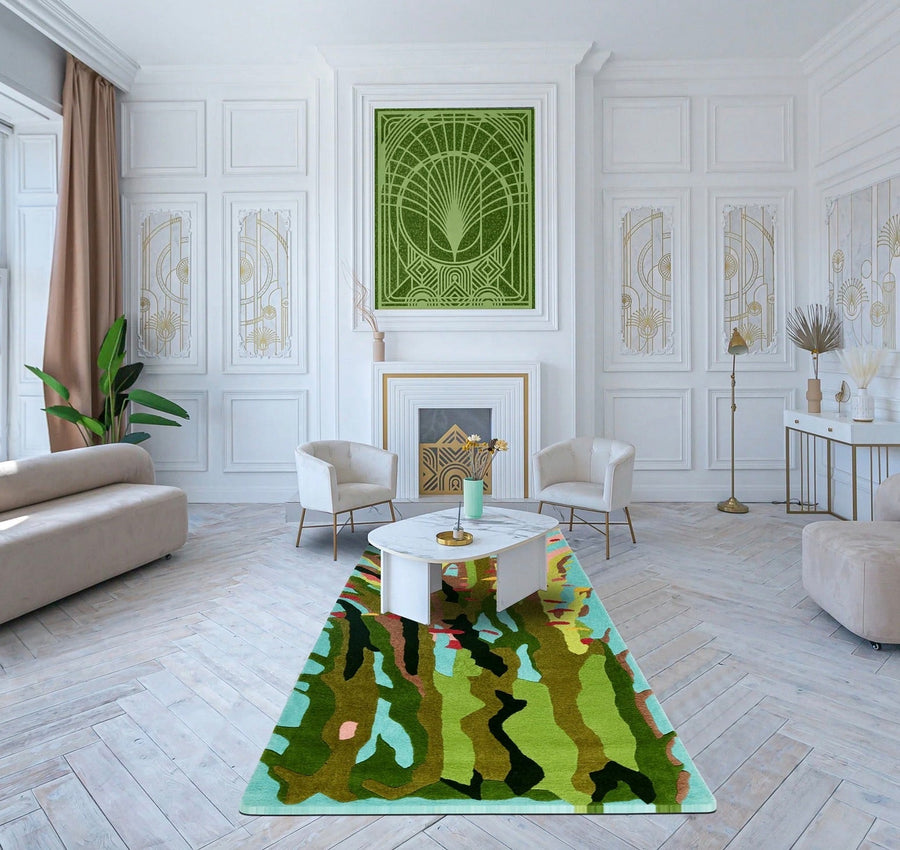
Our collection of modern rugs ranges from abstract compositions in intense colors to botanical designs of Scandinavian inspiration, all the way to textural tone-on-tone surfaces. Some pieces play with depth: the pile is sheared at different heights, creating perspective effects that shift with the light. Others are all about color, with shades moving from turquoise to emerald or from earthy tones to the most delicate powders.
Geometries, abstractions and organic motifs
Each style answers a different need in the room.
- Essential geometries integrate with minimal furnishings and contemporary architecture, wherever rhythm and visual order are needed.
- Abstract motifs add movement and character: they are the ideal choice when the rug is meant to become the focal point of the room.
- Organic and floral designs, such as Nordic-style botanical compositions, soften more rigorous interiors and bring a natural note into urban spaces.
Little secret: a bold pattern needs visual breathing room around it. If the room is already rich in patterns (wallpaper, textiles, artworks), it's better to choose a tone-on-tone contemporary rug, which adds texture without competing with the rest.
The rug as focal point and zoning tool
In large open-plan spaces, the rug performs a precise architectural function: it defines functional zones without the need for walls. One rug under the conversation area, another framing the dining zone: the space gains order and immediate legibility.
At the same time, rugs noticeably improve indoor acoustics. They absorb sound, reduce echo and make rooms feel more intimate and comfortable. A concrete advantage especially in lofts, double-height spaces and rooms with hard surfaces such as stone, resin or wood.
The craftsmanship that makes the difference: hand knotting
Our artisanal rugs are born from an entirely manual process, the same one that has distinguished great collectible rugs from industrial production for centuries.
You may be wondering what "hand-knotted" actually means in practice. It means every single knot is tied by an artisan's fingers, one after another, following the project drawing. Here's how a hand-knotted rug comes to life:
- The designer defines the original drawing and the color palette of the project.
- The yarns are selected, handspun and dyed to the required shades.
- The artisans knot the rug on the loom, knot after knot, following the map of the design.
- The pile is sheared, finished and washed to set the colors and texture.
To give you an idea of the complexity: one of our hand-knotted rugs requires, on average, the work of 3 to 4 artisans over roughly 12 weeks. Not bad, right? It's this density of human labor that makes each piece unrepeatable.
Alongside hand knotting, our collection of hand-knotted rugs is complemented by hand-tufted creations, a technique that allows faster lead times and great creative freedom in the designs, while maintaining a high artisanal standard. The difference? Hand knotting represents the highest level of refinement and durability; hand tufting is perfect for creative projects with tighter deadlines.
Precious fibers for luxury rugs
What truly sets luxury rugs apart is the raw material. The fiber determines the hand of the rug, its luminosity, its resistance to foot traffic and the way it ages over the years. That's why we select only yarns of the highest quality, often combined to achieve distinctive textural and chromatic effects.
New Zealand wool and Himalayan wools
Wool is the queen of textile fibers. Naturally stain-resistant, elastic and insulating, it produces rugs that last for generations. We primarily use handspun New Zealand wool, spun by hand to preserve its softness, and precious high-altitude wools for the most textural designs. Explore the dedicated collections: wool rugs and Himalayan wool rugs. From these high-altitude wools also come our Tibetan rugs, knotted according to the Himalayan manual tradition.
Silk, viscose and Tencel: the luminosity of noble fibers
Lustrous fibers turn the surface of the rug into a play of reflections that changes with the light and the viewing angle. Silk delivers absolute depth and preciousness. Viscose and Tencel (a plant-based silk) offer the same luminosity with a more sustainable approach: you'll find both in our collection of viscose and Tencel rugs, often blended with wool to balance sheen and body. Alternatively, bamboo silk combines a silky hand with a natural fiber.
Please note: our production philosophy also embraces innovative yarns obtained from recycled textile waste. Luxury, today, also travels through environmental responsibility.
Alpaca, cashmere and mohair: the most exclusive touch
For the most refined projects we offer rare fibers, with an incredibly soft hand and a sophisticated look. Alpaca offers warmth and a unique velvety texture. Cashmere is synonymous with absolute softness. Mohair adds natural sheen and lightness. These are the fibers we choose for master bedrooms, hotel suites and spaces where tactile comfort is part of the design brief.
How to choose the right designer rug
At this point, you know the techniques and the materials. The practical question remains: how do you choose the right rug for your space? Here are the rules we ourselves follow when working alongside designers and private clients.
Sizing: rules for living rooms, dining areas and bedrooms
The most common mistake is choosing a rug that's too small. An undersized rug visually shrinks the room and breaks the balance of the furnishings. These are the correct proportions:
- Living room: the rug should reach at least under the front edge of the sofa, or better still, embrace the entire conversation area.
- Dining area: the table and chairs must remain fully within the perimeter, even with the chairs pulled out.
- Bedroom: you can opt for a single large rug extending beyond the bed on three sides, or for two runners along the sides.
- Hallways and entrances: a runner should cover most of the length of the passage, leaving just a few inches free along the edges.
For grand spaces, take a look at our selection of large rugs; for passageways, browse the runner rugs collection.
Shapes: rectangular, round, runner or sculpted
The rectangular shape is the most versatile and adapts to virtually any room. A round rug, on the other hand, converses beautifully with circular tables, curved furniture and compact rooms, creating an immediate focal point. Asymmetrical or sculpted shapes are bold design choices: perfect when the rug is meant to be the artistic gesture of the room.
Colors and patterns for each space
The color of the rug doesn't necessarily have to echo the furniture. Quite the opposite: a well-calibrated contrast often creates more coherence than a perfect match. Clearly, it's always worth considering how the tones interact with the floor and the walls.
Deep tones (midnight blue, forest green) add elegance and visually anchor the furnishings. Light, neutral shades amplify the light and make the room feel larger. Intense hues, from turquoise to emerald all the way to powder pinks, bring energy and personality.
Your next rug is waiting
Let's recap the key points of this guide.
- Designer rugs are textile works born from a project: original drawings, precious fibers and artisanal craftsmanship.
- Hand knotting is the most refined technique: weeks of work and multiple artisans for every single piece.
- The fiber makes the difference: New Zealand wool, silk, Tencel, alpaca and cashmere for different results in aesthetics and durability.
- Every model can be made to measure, including contract and hospitality projects.
All that's left is to move from theory to practice. Explore the collection above and, if you have a specific project in mind, contact us: our team is available for tailored consultations, sampling and dedicated quotes. Which space are you ready to transform?