
Your cart is empty
Tax included and shipping calculated at checkout
Bespoke solutions for interior designers and exclusive projects
Drawer menu
Drawer menu
Tax included and shipping calculated at checkout

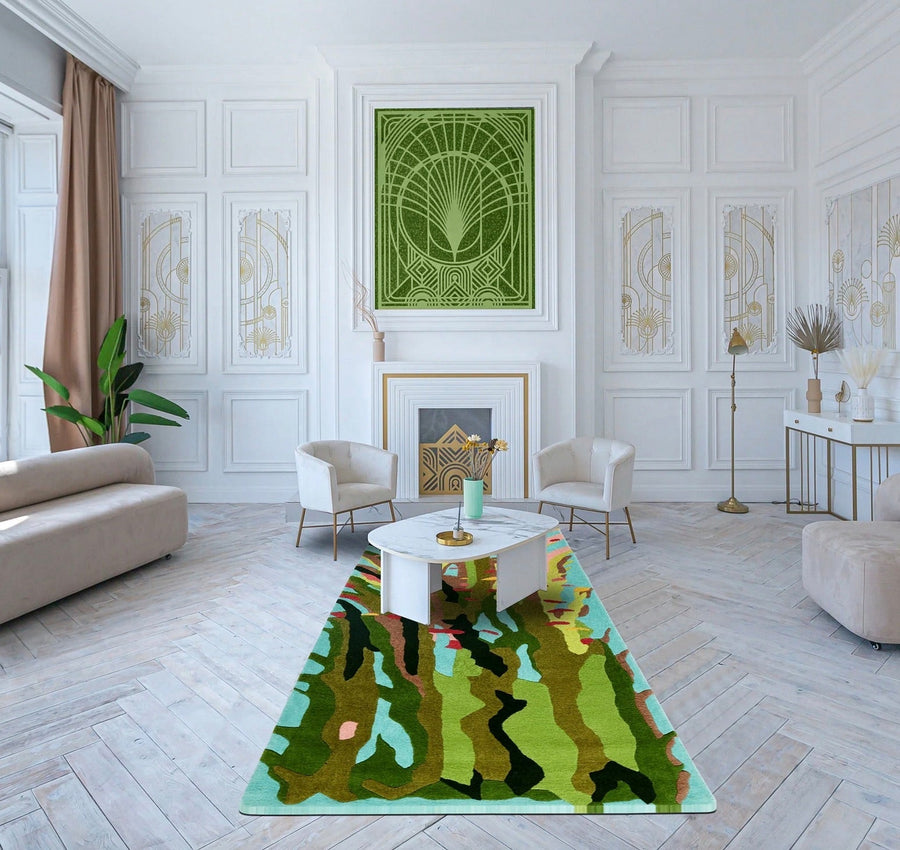
Large rugs don't furnish a room: they define it. As you probably know, once the surface exceeds 6'7"×9'10" (200×300 cm), a rug stops being an accessory and becomes the compositional axis the entire space revolves around. You no longer start from the furniture and look for a matching rug — you start from the rug and build everything else around it.
In our collection you'll find large-format hand-knotted rugs, designed in Italy and crafted with handspun New Zealand wool, plant-based silk, viscose and Tencel. Each piece is born from a dedicated design process (from the graphic concept to the color palette, down to the choice of fiber) and can be developed made to measure in the exact dimensions of your project. A substantial difference from mass-produced large rugs: here we're talking about luxury rugs conceived for grand living rooms, open-plan spaces and representative interiors.
You might be wondering which size to choose, which fiber performs best on a large surface, or how a bespoke project works. In this guide you'll find all the answers, along with a few trade secrets you'll rarely read elsewhere.


A large rug changes how a room is perceived. It does so quietly but radically: it unifies freestanding furniture into a coherent whole, anchors the conversation area and creates what we might call an island of warmth and comfort. One large continuous surface is far more visually calming than scattered elements floating on the floor.
There's an interesting optical effect too. When the rug accommodates all the furniture in the living area (sofa, armchairs and coffee table), the room feels larger, not fuller. Not bad, right?
In open-plan apartments and living rooms with integrated kitchens, a large rug is the only "soft" tool for creating visual separation without raising walls or partitions. Laid under the conversation area, it draws a precise perceptual boundary between the living zone and the dining zone, giving each area its own identity.
A 6'7"×9'10" (200×300 cm) format in a 380–540 sq ft open space doesn't occupy the room: it organizes it. It reduces the visual dispersion typical of undivided interiors and quite literally invites you to linger. This is why architects and interior designers treat it as a design element in its own right, not a mere accessory.
A little trade secret: in large volumes, the first problem is never aesthetic but acoustic. A large wool rug naturally absorbs sound, reduces echo and significantly improves the acoustic comfort of open spaces. Wool, in particular, offers excellent thermal and acoustic insulation: it retains warmth in winter and keeps a fresh feel in summer.
In a loft, a double-height villa or a hotel lobby, this aspect makes the difference between a scenic interior and a genuinely livable one.
As a general rule, a rug is considered large format from 5'3"×7'7" (160×230 cm) upwards. The most requested sizes for generous spaces, however, are 6'7"×9'10" (200×300 cm), 8'2"×11'6" (250×350 cm) and 9'10"×13'1" (300×400 cm), up to oversized formats made to specification.
Before choosing, measure not just the room but the functional zone the rug will need to define. A few practical references:
Please note: the rug should cover at least two thirds of the depth of the conversation area and extend beyond the width of the sofa by 8–12 in per side. A rug that ends before the edge of the sofa creates a visually fragmented effect. Always leave a frame of bare floor along the edges, and never let the rug touch the walls.
With living room rugs, the golden rule is to anchor the main seating. Sofa and armchairs must engage with the rug, never be excluded from it. If space allows, the most elegant solution is always the one that gathers the entire living area onto the textile surface.
All clear so far? Let's move on to the other rooms.
In the bedroom, a large rug is usually placed partially under the bed: it should extend at least 20 in on each side and 24–31 in at the foot. For a king or queen bed, the recommended minimum size is 6'7"×9'10" (200×300 cm). Getting up in the morning and setting your feet on soft wool, rather than a cold floor, is one of those everyday luxuries you don't describe: you live it.
In the dining area, the rug must allow the chairs to remain on its surface even when pulled away from the table. For a table seating 6–8, you'll need at least 8'2"×11'6" (250×350 cm).
And what if your space doesn't fit the standards? That's where custom rugs come in: bespoke dimensions, proportions calibrated to the millimeter, elongated shapes such as runner rugs for stairs and hallways, or special outlines for irregular floor plans. In essence, the rug is designed around your space — not the other way round. Custom dimensions are available on request for almost every model in our collection.
At this point, let's talk about the real difference between an ordinary rug and a luxury rug: the making technique.
Hand-knotted rugs represent the highest level of textile refinement. Every single knot is tied by hand by specialized artisans: a large-format piece requires the work of 3–4 artisans for around 12 weeks. Twelve weeks for a single rug. This is the pace of excellence - and it's also the reason a hand-knotted rug crosses the decades keeping its structure and beauty intact.
Our rugs are born from a graphic design developed in Italy and are handcrafted in India, where the tradition of hand knotting reaches levels of knot density (such as 4/25 quality) that no mechanical production can replicate. The result? One-of-a-kind pieces, with subtle variations that are the signature of authentic craftsmanship.
You might be wondering how this differs from hand-tufted. Simplifying: in a hand-knotted rug every knot is tied individually to the warp, while in a tufted rug the yarn is punched through a backing cloth with a tufting gun. Hand tufting allows for quicker, more accessible creative solutions while retaining an artisanal character. Hand knotting, however, remains the absolute benchmark for durability, precision of design and long-term value.
On a 9'10"×13'1" (300×400 cm) surface, every flaw is amplified. A high knot density guarantees crisp patterns, straight edges and a surface that won't deform over time, not even under the weight of furniture. At the same time, the knotted structure distributes tension evenly: a technical aspect invisible to the eye, yet decisive for an investment of this scale.
On a large format, the fiber isn't a detail: it's the character of the rug. Every material behaves differently as the surface grows.
Handspun New Zealand wool is the quality choice par excellence for large formats. It's naturally resilient (the fibers spring back after compression), resistant to foot traffic and extraordinarily long-lasting. Discover our selection of wool rugs: warmth, body and that tactile texture that makes a room instantly welcoming. And if you're after an even more precious softness, the noble fibers of our cashmere rugs and alpaca rugs take tactile comfort to another level.
Lustrous fibers turn light into decoration. Silk rugs and viscose weaves create shimmering reflections that become truly scenic on large surfaces: the rug shifts in tone depending on where you stand and the time of day. Tencel, a plant-based silk, combines the same sheen with an incredibly soft hand. The wool & viscose and wool & Tencel blends of our viscose and Tencel rugs offer the best of both worlds: the structure of wool, the luminosity of a noble fiber.
One element not to overlook: sustainability. Some of our rugs use innovative yarns derived from recycled textile waste, alongside certified natural fibers such as those of our bamboo silk rugs, lustrous and plant-based. Luxury and environmental responsibility can live in the same knot — and contemporary design increasingly demands it.
Not all patterns behave the same way as the format grows. Large-scale geometric motifs gain strength and legibility on big formats, while small-repeat designs read as mere texture. Abstract decors with gradients (degradé, watercolor effects) reach their full expression only on extended surfaces: it's like giving a painter a larger canvas.
In our collection you'll find modern rugs with a contemporary language, designer rugs with organic, botanical patterns of Scandinavian inspiration, and oriental rugs such as the classic Oushak, reinterpreted in current palettes (sea green, navy blue, peach tones).
A practical tip: if the room is already rich in elements, a monochrome rug in a solid color on a large format is the most architectural choice. If your furnishings are minimalist instead, a patterned rug becomes the defining element of the entire room. Rug and furniture shouldn't compete: they should converse.
With a large format, the safest strategy is to start from a neutral base (warm grey, beige, sand) and build the pairing with the accent colors of your furnishings. You can of course flip the logic: a boldly contrasting rug as the absolute protagonist, with the furniture playing supporting roles. In made-to-measure projects, the palette is calibrated directly on the materials and finishes of your interior.
A rug of this level is an investment, and it deserves to be protected. The good news? The routine is simple:
With this level of care, a hand-knotted rug in New Zealand wool will accompany a home for generations. Literally.
To recap the key points:
At this point you have everything you need to choose. Explore the collection above, or contact us for a bespoke project: every enquiry receives our personal, confidential attention. Your space deserves a rug designed exactly for it — don't you think?
Perhaps you work as an interior designer, or you're handling the project for a villa, a suite or a lobby. In that case, a large-format rug isn't a purchase: it's a project specification.
That's why we've developed a dedicated path for architects and interior designers: we collaborate from concept to final production, with the possibility of defining pattern, dimensions, color palette and fiber according to the vision of the project. A service that large rug e-commerce platforms simply cannot offer.
The flow is linear. We start from the graphic concept, define the palette through moodboards and real samples, choose the fiber (wool, silk, Tencel or blends) and set the exact dimensions. Then artisanal production takes its time, around 12 weeks, and the rug arrives exactly as you imagined it. In essence: a one-of-a-kind piece, born for a single space.
For boutique hotels, restaurants and multi-unit residential projects we offer a contract and hospitality service with coordinated supplies, reliable timelines and a single point of contact for the entire duration of the commission. Large formats are often the heart of these projects: a lobby with a 9'10"×13'1" (300×400 cm) hand-knotted rug communicates the positioning of the property before check-in even begins.
For a medium living room with a 3-seater sofa, start from 6'7"×9'10" (200×300 cm). For generous rooms and open spaces, sizes from 8'2"×11'6" (250×350 cm) upwards give the living area a defined, coherent look. The practical rule: at least the front legs of sofas and armchairs must rest on the rug.
The price depends on technique, fiber, knot density and dimensions. A hand-knotted rug in New Zealand wool carries a higher value than a tufted one, proportional to the roughly 12 weeks of artisanal work involved. Contact us with your measurements and project type: you'll receive a dedicated, confidential quotation.
A large-format hand-knotted rug requires on average 12 weeks of work, with 3–4 artisans engaged on the same loom. Design and shipping times should be added to the production schedule.
Yes, and significantly. Large textile surfaces absorb sound and reduce echo in spacious rooms and open-plan layouts. Wool rugs are the most effective for acoustic insulation, thanks to the natural density of the fiber.

Bespoke design and custom decor: chandeliers, rugs, mirrors and wallpaper created for your project. From concept to finished piece, with Italian artisans.