
Your cart is empty
Tax included and shipping calculated at checkout
Bespoke solutions for interior designers and exclusive projects
Drawer menu
Drawer menu
Tax included and shipping calculated at checkout

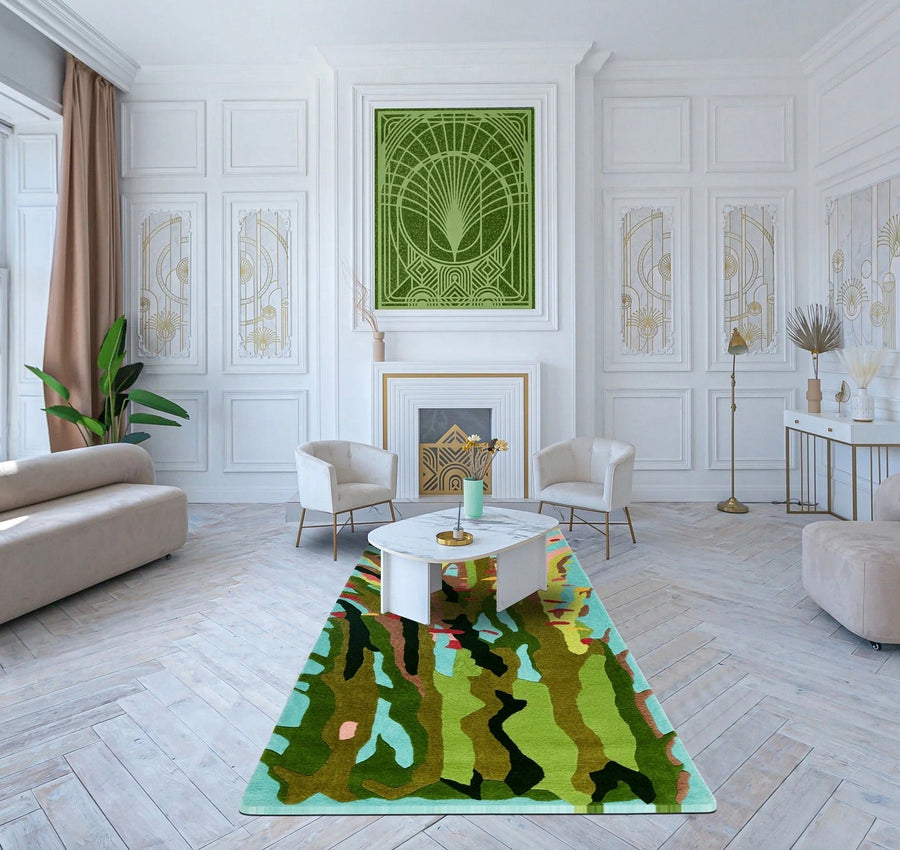
Tibetan rugs are hand-knotted rugs made with a technique that exists nowhere else in the world: the Tibetan knot, a weaving method that loops the yarn around a rod and two warp threads, creating a dense, compact and remarkably even surface. The raw material is almost always a high-altitude wool rich in lanolin, the natural substance that makes these rugs among the softest and most resilient you can bring into a home. The result? A piece that combines a centuries-old artisan tradition with a surprisingly contemporary aesthetic.
As you may know, not all hand-knotted rugs are created equal. Tibetan rugs stand apart from classic oriental rugs precisely because of their construction: fast, regular knots, a pile controlled to the millimetre, and designs that favour clean lines and muted palettes over the dense motifs of the Persian tradition. This is exactly why interior designers and collectors have been choosing them for decades for the most refined décor projects.
In this collection you will find Tibetan rugs hand-knotted in fine wools, silks and natural fibres, curated for those seeking luxury rugs with an authentic character. And if you have a specific project in mind, every model can be made to measure: dimensions, colours and design adapt to your space, not the other way around.


Let's start with the basics. A Tibetan rug is a rug made with the knotting technique developed on the Himalayan plateau, where wool weaving has been part of everyday life for centuries. The nomadic peoples of Tibet used these pieces as saddle rugs for long journeys on horseback, as blankets, as gifts for monasteries and, above all, as kaden, the traditional sitting and sleeping rug.
In essence, in Tibet the rug was never a mere decorative accessory: it was a practical, spiritual and social object all at once. This practical origin explains its structural quality. A rug designed to last for generations has to be dense, robust and capable of ageing beautifully.
Today the term covers both historical pieces and contemporary rugs made with the same technique, mainly in Nepal and India, where Tibetan craftsmanship relocated and experienced a true renaissance. You may be wondering whether that diminishes their value. Quite the opposite: it is precisely in the Himalayan and Indian workshops that the Tibetan knotting tradition reached its qualitative peak, with densities of up to 100 knots and beyond.
The Tibetan knot is what truly sets these rugs apart from any other hand-knotted piece. Here is how it works: the yarn is looped continuously around two warp threads and then around a temporary rod placed in front of the loom, which sets the height of the pile. Once a row of loops is complete, the artisan cuts the loops along the rod to form the knots.
A little trade secret: when the loops are left uncut, you get what is known as loop pile, a surface of continuous loops with a textural, tactile character. When they are cut, you get cut pile, the smooth, velvety surface typical of the finest Tibetan rugs. Many contemporary designs combine both finishes within the same rug, creating plays of relief and glossy-matte contrasts reminiscent of brocades and damask fabrics.
This technique makes the knotting faster and more regular than the Persian knot. The result is a homogeneous surface, perfect for modern designs, broad colour fields and subtle gradients.
Now that you understand the technique, the comparison with Persian rugs becomes straightforward. There are three main differences.
Neither tradition is "superior" to the other, of course. They are different languages. If you love the great classics of oriental rugs, a Persian rug remains a timeless choice. If instead you are looking for an artisan piece that speaks to contemporary interiors, the Tibetan rug is probably the answer you need.
At this point, let's talk about the real protagonist: the wool. The quintessential Tibetan wool comes from changpel sheep, raised on the highlands of the Himalayas at altitudes between 4,500 and 5,500 metres. In such a harsh climate, the animal develops a long, elastic and extremely resilient fibre, with a concentration of lanolin far above average.
Why does lanolin matter so much? This natural waxy substance performs three precious functions. It protects the fibre from stains, creating a natural water-repellent barrier. It keeps the wool from drying out over the years, preserving its softness to the touch. And as the dye soaks into the fibre, it develops that luminous, deep patina that separates a fine rug from an ordinary one.
Not bad, is it? Due to the complex geopolitical situation of the region, changpel wool is now complemented by wools of the highest quality from other territories, such as handspun New Zealand wool, hand-spun and very similar in texture and performance. What truly matters in a contemporary Tibetan rug is the combination of fine fibre, hand spinning and artisan knotting: it is the philosophy behind our selection of Himalayan wool rugs.
Wool is the foundation, but it is not the only material. Contemporary Tibetan knotting works with a range of natural fibres that vastly expands its expressive possibilities.
A good method is to choose the fibre combination according to how the room is used: pure wool rugs remain the most versatile and durable choice. Pure wool for high-traffic areas, wool-silk or wool-viscose blends for rooms where light matters most, plant fibres for distinctive textures. If in doubt, our team can guide you towards the yarn best suited to your project.
Colours tell much of the story of these pieces. Originally, Tibetan weavers had only four natural dyes at their disposal: madder for red, indigo for blue, Tibetan rhubarb for yellow and walnut for shades of brown and grey. From this essential palette comes the chromatic identity of the Tibetan rug: soft, deep tones that never shout.
Today the range of available colours is virtually endless. Yet the best contemporary designs remain faithful to that original sensibility, with natural palettes that integrate into interiors without dominating them. In our custom projects, the colour choice always starts from your space: yarn samples dyed ad hoc allow every shade to be calibrated against the actual light of the room.
All clear so far? Good, because now comes the part that will save you costly mistakes. The market is full of rugs sold as "Tibetan" that have very little Tibetan about them. Here are the criteria that truly matter.
Please note: slight variations in colour and weave in a hand-knotted rug are not flaws. They are the artisan's signature — proof that no other rug in the world is identical to yours.
This is where much of a rug's value is decided. A hand-knotted rug is born knot by knot on the loom: each thread is tied by hand to the warp, with production times that can exceed twelve weeks and involve three or four artisans working together. A hand-tufted rug, on the other hand, is made by inserting the yarn into a backing cloth with a tufting gun: the pile is stitched, not knotted, and is fixed on the back with a layer of latex.
The difference can be seen and felt. A knotted rug lasts for generations, develops patina, can be restored and holds its value over time. Tufting is a faster, more economical solution — legitimate for certain uses, but with a much shorter lifespan. That is why, when we speak of luxury Tibetan rugs, we always and exclusively mean hand-knotted rugs.
You may be wondering what those numbers actually indicate: 60 knots, 80 knots, 100 knots. It is the number of knots per linear inch, and it determines the fineness of the design, the height of the pile and the tactile character of the rug.
A word of caution: more knots does not automatically mean "better". It means "different". A 60-knot rug in pure wool can be the perfect choice for a living room with a textural feel, while a 100-knot wool-silk piece expresses its full potential in a master bedroom or an executive study. The right density depends on the project, the use and the aesthetic effect you want to achieve.
A few words of history help you understand what you are bringing into your home. Knotting in Tibet has ancient roots, tied to the nomadic and monastic culture of the plateau, but it was documented in the West only from the early twentieth century. For centuries, rugs accompanied Tibetan daily and spiritual life: the kaden for sleeping and sitting, meditation rugs, wool saddle rugs for journeys on horseback, gifts for monasteries.
The turning point came in 1959, when the Tibetan diaspora brought thousands of artisans to India and Nepal. It was in the Kathmandu valley and in Indian workshops that the art of Tibetan knotting was reborn and gained international recognition, meeting Western designers and opening up to a contemporary language. The symbols of tradition — the sacred gau, tigers, dragons, snow lions, lotus flowers and the celestial clouds of the Buddhist repertoire — now coexist with abstract compositions, minimal geometries and designer patterns.
For this reason, a contemporary Tibetan rug is not a copy of the past. It is the living evolution of a tradition that has travelled through history without losing its identity.
And here we come to the point that truly matters to anyone who designs spaces. Why does the Tibetan rug work so well in today's interiors? The answer lies in its nature: a uniform surface, controlled palettes, and designs that range from minimal to decorative without ever becoming intrusive.
The Tibetan rug is among the most versatile of all. Perhaps you are designing a minimalist living room: here a single-colour Tibetan rug, or one with subtle geometries, becomes the textural focal point that warms the space without weighing it down. Or you are working on a mid-century interior: wool-silk textures and natural palettes converse beautifully with dark woods, brass and reinterpreted late-century surfaces.
In a contemporary classic setting, a Tibetan rug echoing traditional motifs creates that bridge between eras that makes a space layered and personal. It works in the living room, where it defines the conversation area. In the bedroom, where the softness of Himalayan wool is a pleasure under bare feet every morning. In a study or a stately entrance hall, where a hand-knotted piece instantly communicates the calibre of the project.
An element not to be overlooked: the size. A stunning rug in the wrong dimension loses much of its effect. Here are the rules we apply in our own projects.
A little trade secret: in open-plan spaces, two rugs of different sizes but coordinated palettes define functions better than any wall. And if standard sizes are not enough, you move to bespoke.
Let's recap the key points.
At this point you have everything you need to choose with confidence. All that remains is to move from theory to your own space: explore the Tibetan rug collection or tell us about your project. The perfect rug for your space may not exist yet — we can create it together.
Here we enter the territory that belongs to us most. Every Tibetan rug in our collection can be developed like our custom rugs, starting from your project: oversized dimensions, special shapes (round, square, shaped), palettes calibrated on the actual space, exclusive designs developed by our studio.
The process is design-driven in the fullest sense. It starts with the graphic concept and the choice of fibres, moves through the weaving map (the carpet map that guides the artisans knot by knot), and arrives at the artisan production, which for a quality hand-knotted rug takes an average of twelve weeks of work. The result is a one-of-a-kind piece, quite literally unrepeatable, born for your space.
If you are a design professional, this section is for you. Every day we work with architects and interior designers and design studios looking for a technical partner, not a mere supplier.
What does that mean in practice? Support in defining fibres, knot densities and palettes according to the specification. Yarn samples and colour pom-poms for on-site verification. Development of exclusive designs coordinated with the interior scheme. Management of supplies for contract & hospitality projects: hotels, prestigious residences, representative spaces, with planned timelines and volumes.
Design takes place in Italy, while production is entrusted to artisan workshops specialising in hand-knotting, with a transparent and ethical supply chain. In essence: a single point of contact from concept to delivery, with the discretion that high-level projects demand.
The price depends on four factors: knot density (60, 80 or 100 knots), fibres used (silk affects the price more than wool), dimensions and design complexity. A quality hand-knotted Tibetan rug is a significant investment, but its lifespan is measured in generations. For custom projects, the quotation is prepared on a project-by-project basis.
Routine maintenance only requires regular vacuuming, without aggressive rotating brushes and following the direction of the pile. The natural lanolin in the wool repels dirt and makes the rug surprisingly easy to maintain. For stains, blot immediately with a damp cloth without rubbing. Every few years, a professional wash designed for hand-knotted rugs restores brilliance to fibres and colours.
There is no difference in technique: both use the same Tibetan knot. The distinction concerns the place of production: after the diaspora of 1959, Tibetan craftsmanship developed mainly in Nepal and India, where the most qualified workshops operate today. The term "Tibetan rug" therefore refers to the technical and stylistic tradition, rather than to geographical provenance.
Yes, provided they are authentically hand-knotted. A hand-knotted Tibetan rug in fine fibres holds — and often increases — its value over time, develops a patina that makes it more beautiful with the years, and can be restored. It is one of the few furnishing elements that gets handed down.

Bespoke design and custom decor: chandeliers, rugs, mirrors and wallpaper created for your project. From concept to finished piece, with Italian artisans.