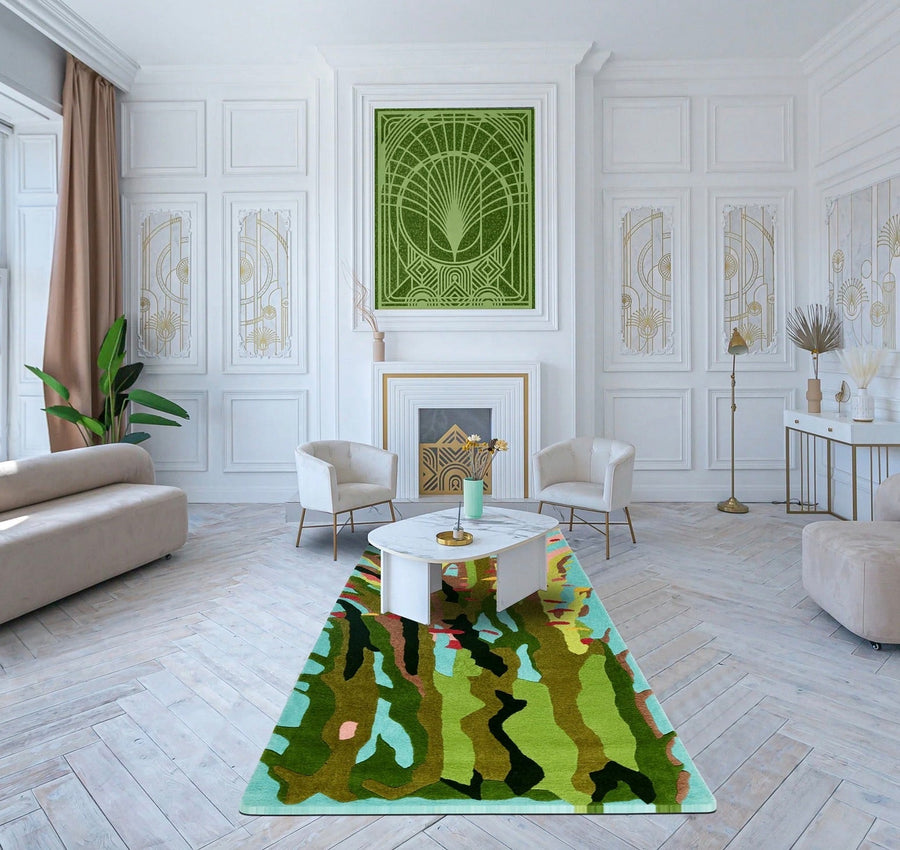
What are viscose and Tencel rugs
Let's start with the basics. Viscose and Tencel rugs are textile works made from fibers derived from wood cellulose, processed into fine yarns that are soft, lightweight and extraordinarily luminous. Both fibers belong to the family of so-called plant-based silks: materials of natural origin that replicate the sheen and silky hand of animal silk, with a more sustainable profile and superior workability.
You might be wondering what actually sets the two apart. Let's clear that up right away, because this is precisely where the quality of a rug is decided.
Viscose, the fiber the masters call vegetable silk
Viscose is a fiber of plant origin obtained from wood cellulose, mainly from conifers and eucalyptus. Through a process that transforms the pulp into continuous filaments, the result is a yarn that industry insiders have always called artificial silk or art silk.
The reason is obvious at first glance. The surface of a viscose rug reflects light with a brilliance no wool can match, creating plays of light and shadow that shift according to the viewing angle (an effect that becomes particularly theatrical in intricate patterns and floral motifs). To the touch, the pile feels soft, cool and velvety.
Please note: pure viscose is a delicate fiber, sensitive to moisture and heavy foot traffic. For this reason, in luxury rugs it is almost always blended with wool or paired with more technical fibers, uniting beauty and durability. More on that in a moment.
Tencel, the sustainable evolution of viscose
Tencel (the commercial name for lyocell) represents the next evolutionary step. Here too, the raw material is cellulose, mostly from eucalyptus sourced from responsibly managed forests. The difference lies in the process: Tencel is produced in a closed loop, with non-toxic solvents that are recovered and reused almost entirely.
The result? An eco-friendly, recyclable fiber that is stronger than traditional viscose, with a soft, deep luster and excellent breathability. The pile of a Tencel rug stays cool to the touch and shows remarkable resistance to pilling, those annoying little surface bobbles.
Little secret: in textile circles, Tencel is often described as plant-based silk. A definition that perfectly captures its dual nature, precious in appearance and responsible in origin.
Viscose and Tencel compared with silk
At this point, the question naturally arises: why choose viscose and Tencel over pure silk? Silk rugs remain the absolute pinnacle of the textile tradition, with a pearlescent depth of color that has few rivals.
At the same time, they come with very high costs and a delicacy that limits everyday use. Viscose and Tencel offer a remarkably similar visual result (sheen, silky hand, shifting reflections) with three concrete advantages:
- Greater versatility: especially when blended with wool, they cope far better with the real life of a home or a hotel suite
- More accessible production times and costs: with the same artisanal knotting, the value is concentrated in craftsmanship and design
- A sustainable profile: fibers derived from cellulose, with Tencel produced in a closed loop and compatible with yarns regenerated from recycled textile waste
Not bad, right?
Why a viscose and Tencel rug is a fine rug
Let's clear up a common misconception right away. The value of a rug doesn't depend on the fiber alone, but on the meeting of noble material, weaving technique and design. Fine rugs in viscose and Tencel are born precisely from this alchemy.
The shifting luster that captures the light
It's the feature that wins you over at first glance. Viscose and Tencel fibers have a structure that reflects light directionally: the rug takes on different tones and reflections depending on where you stand and the time of day.
In a living room with large windows, this translates into a living surface that converses with natural light from dawn to dusk. Bright, vivid colors amplify the effect even further, but neutral and powdery palettes (beige, pearl grey, taupe) also gain a material depth impossible to achieve with matte fibers.
Hand-knotting: the value of time
Here we enter the heart of what makes these pieces precious. Our hand-knotted rugs are born from a process that allows no shortcuts: every single knot is tied by hand by specialized artisans, following a design developed in Italy.
To give you a concrete idea: a generously sized hand-knotted rug requires the simultaneous work of three or four artisans for around twelve weeks. We're talking about millions of knots, tied one by one.
Knot density determines the definition of the pattern, just as pixels determine the resolution of an image. The finer the knots, the sharper, more detailed and more precious the motif becomes. For this reason, hand-knotting remains the highest level of textile refinement, the one that separates a true artisanal work from a mass-produced item.
For creative projects with tighter timelines, the hand-tufted technique offers a high-quality alternative, still executed entirely by hand.
Noble fibers and blends: wool and viscose, wool and Tencel
As I mentioned earlier, the real design intelligence lies in the blends. Combining handspun New Zealand wool with viscose or Tencel means uniting the best of two worlds.
Wool brings body, elasticity and a natural resistance to wear and creasing. Viscose and Tencel add luster, softness and that silky tactile dimension that defines contemporary luxury. The result is a rug where the areas of lustrous fiber emerge from the wool ground, creating material contrasts of great refinement (a technique widely used in botanical patterns and organic motifs). If you love the natural warmth of animal fiber, we recommend exploring the wool rugs collection as well: you'll find the same artisanal care expressed in a more textured register.
Which rooms bring out the best in a viscose and Tencel rug
All clear so far? Good, let's get practical: where to place these rugs so they perform at their finest.
Bedrooms and sleeping areas: softness and intimacy
The bedroom is the natural habitat of a viscose and Tencel rug. Foot traffic is low, you often walk barefoot, and the velvety softness of the pile delivers an immediate sense of comfort the moment you wake up.
What's more, the sheen of the fibers amplifies the soft lighting typical of sleeping areas, contributing to an intimate, enveloping atmosphere. An oversized rug extending well beyond the perimeter of the bed creates that hotel-suite effect that never goes out of style.
Living rooms and statement spaces
In the living room, a viscose and Tencel rug becomes the absolute protagonist, especially beneath the conversation area: this is where modern rugs with shimmering surfaces express their full personality. Here, though, honesty is required: these fibers are more delicate than wool, sensitive to moisture and intense foot traffic.
We therefore recommend favoring wool-viscose or wool-Tencel blends for busier living areas, reserving predominantly silky piles for statement and formal spaces. Watch out for heavy furniture too: the legs of armchairs and chests of drawers can leave permanent marks on the pile, so it's best to plan the layout before installation.
Suites, boutique hotels and hospitality spaces
There's one setting where these rugs truly put on a show: high-end hospitality. In a suite, the combination of luster, softness and exclusive design instantly communicates the positioning of the property.
For contract projects we develop rugs with dedicated specifications: blends calibrated to the expected traffic intensity, dimensions coordinated with the rooms, and designs consistent with the property's visual identity. A detail guests remember, and one that makes a difference in the reviews.
How to care for a viscose and Tencel rug
A precious work deserves care to match. The good news is that routine maintenance is simple, as long as you follow a few essential rules:
- Vacuum regularly and gently, without aggressive rotating brushes, following the direction of the pile
- Avoid contact with water and liquids: viscose absorbs moisture quickly and can stain or mark permanently
- Blot spills immediately with a clean, dry cloth, without rubbing
- Rotate the rug roughly every six months, to even out exposure to light and foot traffic
- Protect the pile from heavy furniture by using wide felt pads under the legs
Everyday cleaning and habits to avoid
The number one enemy is moisture. Avoid placing the rug in humid rooms and never use steam cleaners or DIY wet washing: the risk of permanent watermarks is real. Prolonged direct sunlight also deserves attention, as over time it can alter the more intense tones.
When to rely on professional cleaning
For deep cleaning, there's only one answer: professional dry cleaning, carried out by specialists who understand cellulosic fibers. A specialist clean every two to three years keeps the pile radiant and considerably extends the life of the piece. In short: fewer DIY interventions, more expert care.
Sustainability: luxury that respects the environment
There's one final aspect particularly close to our hearts. Contemporary luxury cannot ignore environmental responsibility, and cellulosic fibers move exactly in this direction.
Tencel comes from wood grown in responsibly managed forests and is produced through a closed-loop process that recovers water and solvents. Viscose shares the same renewable, plant-based origin. In our projects we also integrate innovative yarns regenerated from recycled textile waste, alongside certified natural fibers such as New Zealand wool.
The result is a piece that unites beauty, craftsmanship and ecological awareness. A value your clients, or your guests, are increasingly able to recognize.
The right rug is the one designed for your space
Let's recap the key points:
- Viscose and Tencel rugs offer the sheen and softness of silk with greater versatility and a sustainable profile
- Hand-knotting and blends with fine wool transform these fibers into works built to last for decades
- Every rug can be created to measure, from pattern to palette, with a dedicated service for architects, interior designers and hospitality projects
- Proper care (gentle vacuuming, no water, periodic professional cleaning) preserves their beauty over time
At this point you have everything you need to choose with confidence. Explore the collection and let the reflections of the fibers guide you, or tell us about your project: contact us for a dedicated, confidential consultation. Which room are you ready to transform?