
Your cart is empty
Tax included and shipping calculated at checkout
Bespoke solutions for interior designers and exclusive projects
Drawer menu
Drawer menu
Tax included and shipping calculated at checkout

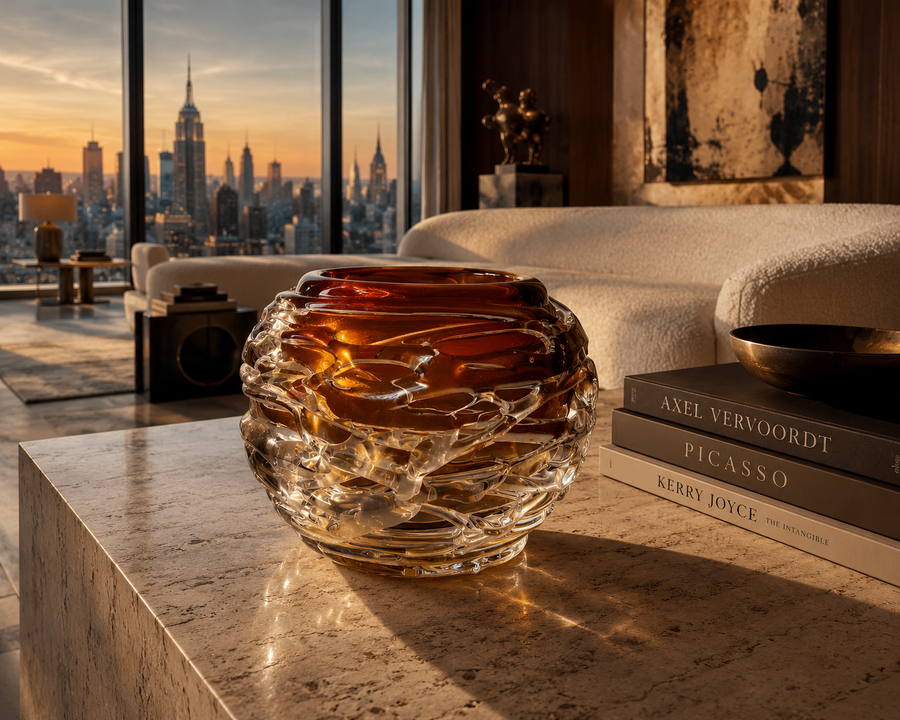
Are you looking for a Murano glass vase that goes beyond a simple decorative object, something closer to a work of art capable of transforming a room entirely? Then you're in the right place. The Murano vases in our collection are born on the island of Murano, in Venice, where Venetian master glassmakers have passed down an artisanal knowledge spanning more than ten centuries from one generation to the next; who we are and how we work is all on our dedicated page. Every piece is mouth-blown, hand-shaped, unique by definition and certified Vetro Artistico® Murano by the Consorzio Promovetro Murano.
On this page you'll find:


To speak of Murano glass vases is to speak of one of the most extraordinary artisanal heritages in the world. The history of Venetian blown glass takes root in the thirteenth century, when the Venetian glassworks were relocated to the island of Murano to protect their production secrets. Since then, every generation of master glassmakers has refined techniques, gestures, and knowledge that still define the quality of each piece today.
The furnace burns at over one thousand degrees Celsius. The master introduces the crucible with a measured, calibrated gesture — identical to that of his predecessors centuries ago. The silica sand transforms under extreme heat: it liquefies, takes on colour, and lights up with an iridescent glow that already hints at the final form.
Please note: this is not serial production in any sense. Every vase emerges from a continuous dialogue between the master and the material — a process in which no two pieces are ever perfectly identical, and the micro-variations in texture, colour, and transparency are considered the authentic hallmark of Venetian craftsmanship, not a flaw.
You might be wondering what sets a Murano vase apart from any other decorative glass object. The answer lies in the technique — or rather, in the multiplicity of techniques that the Venetian tradition has developed over the centuries.
Mouth-blowing is the foundational gesture of the entire glassmaking tradition of Murano. The master glassmaker gathers a small amount of molten glass with the blowpipe — a metal tube roughly one and a half metres long — and breathes into it with precise, controlled pressure. The blown glass slowly expands, like a bubble taking shape in the warm air of the furnace. At that point the shaping begins: using pliers, moulds, and ancestral tools, the master forms the glass while it is still soft and malleable, giving it its final shape before it cools and solidifies.
It is a process that takes just a few minutes — and requires decades of practice to truly master.
The murrina millefiori technique is among the most fascinating and recognisable in Venetian craftsmanship. Murrine are cross-sections of coloured glass rods — each containing an internal pattern that may be floral, geometric, or abstract. When fused and incorporated into the blown glass of the vase, the pattern reveals itself only in cross-section or through transparency: an almost magical effect that has captivated collectors and designers around the world for centuries.
Filigrana is the technique by which coloured glass filaments — often white lattimo — are incorporated into the molten mass and distorted during working to form spiral, braided, or interlaced patterns. Reticello takes this technique a step further: two layers of filigrana glass are superimposed in opposite directions, creating an extremely fine internal lattice with tiny air bubbles trapped at the intersections — a result that took centuries of refinement to achieve consistently.
Lattimo, meanwhile, is a milky-white glass obtained by adding tin oxide or arsenic to the base mixture: translucent, visually soft, it is frequently used in vases as a contrasting element against transparent or coloured surfaces.
Pulegoso is one of the most evocative techniques in the Murano tradition: it consists of incorporating air bubbles into the molten glass mass during working, creating a textural effect reminiscent of a volcanic stone surface. The result is an object that plays with light in an entirely different way from smooth glass — with a visual density that shifts depending on the angle.
The iridescente finish, on the other hand, is achieved by spraying metallic salts onto the surface of the still-hot glass, producing that characteristic shimmering effect that calls to mind peacock feathers or dragonfly wings. It is a technique particularly valued in combination with wall sconces and chandeliers, but it yields extraordinary results on decorative vases as well.
At this point, it is worth exploring the main families of decorative vases available in our collection — because each style responds to very different aesthetic needs.
Classic Murano vases draw on the great Venetian tradition of display glassware: round or flask-shaped forms, long slender necks, transparent or lightly coloured surfaces worked with metallic oxides. Often crafted with details in 24k gold applied as leaf or powder, these pieces dialogue beautifully with classic, neoclassical, or baroque revival interior design environments.
For those drawn to this aesthetic register, you may also wish to explore our Murano glass centerpieces collection — conceived precisely to enhance dining tables and display cabinets in prestige residences.
Unlike their classic counterparts, design vases in Murano glass are distinguished by asymmetric forms, broken geometries, and bolder chromatic palettes. Many international designers — from Carlo Scarpa to figures of the contemporary scene — have found in Murano blown glass the ideal medium for expressing radically modern visual languages. These vases are particularly sought after by interior design professionals looking for an element capable of being both functional and visually declarative at once.
Coloured Murano vases are perhaps the most immediately recognisable pieces in Murano production. Colours are obtained by adding metallic oxides to the glass mixture: cobalt oxide for blue, manganese oxide for violet, copper oxide for green and ruby red. Each shade has a precise technical history — and the final result depends not only on the chemical composition, but also on the firing temperature and the blowing technique adopted by the master.
The vintage Murano glass market is among the most dynamic in the collectible design segment. Pieces made between the 1950s and 1970s — particularly those inspired by the work of masters such as Mazzega, or the productions of the great historic glassworks — are today sought after by private collectors, galleries, and interior designers worldwide; if you love this period, you'll find the same spirit in our vintage Murano chandeliers. Our selection of vintage Murano vases brings together authentic period pieces, selected for quality, documented provenance, and state of preservation.
A small but important detail: if a vase declared to be "Murano glass" is geometrically perfect, symmetrical to the millimetre, and entirely free of any internal chromatic variation, it most likely was not blown by hand. Authentic Murano glass vases always carry small irregularities — a slight asymmetry in the profile, a tonal variation in the colour, a millimetric bubble trapped within the thickness — which are the unreproducible signature of the human gesture. These are not defects: they are the physical evidence of a craft process in which no machine can replace the sensitivity of the master.
Unlike industrial design vases, pieces in Murano blown glass have an optical three-dimensionality that shifts with the light, with the time of day, with the position of the viewer. This quality makes them ideal as focal points in high-end residential environments, boutique hotels, executive suites, and contract spaces where a genuinely authentic visual experience is the goal.
Our contract and hospitality division supports designers and procurement teams in the selection and supply of decorative vases in Murano glass for boutique hotels, prestige private residences, yachts, and high-end hospitality properties. We manage multiple-piece orders with precise technical specifications, guaranteeing aesthetic consistency across pieces within the same supply and adherence to agreed delivery schedules.
There are few objects in the world capable of being at once works of art, furnishing elements, and long-term investments. Murano vases are among them.
The intrinsic uniqueness of every hand-blown piece makes them collectible objects by definition: no two vases are identical even when produced by the same master glassmaker using the same materials and the same technique. To this is added the historical value of the techniques employed — filigrana, murrina, reticello — which are UNESCO intangible cultural heritage, and which every piece carries within itself as documented cultural legacy.
A certified Murano glass vase accompanied by origin documentation is one of the most appreciated luxury gifts in the Italian fine craft segment. It is fitting for the inauguration of prestige residences or offices, for corporate occasions where one wishes to convey an exceptional level of attention, and for private collectors seeking pieces with a strong visual identity and a verifiable story — for the latter, we invite you to also discover our private design collections.
The history of Murano artistic glass in the twentieth century is inseparable from the names of the great designers who chose the Venetian island as their creative laboratory. Paolo Venini, Fulvio Bianconi, Carlo Scarpa, Napoleone Martinuzzi — figures who transformed the glassmaking tradition into a design language recognised internationally. This cultural heritage is what makes every authentic Murano vase not merely a beautiful object, but a piece of Italian design history.
In our selection you will also find pieces inspired by this tradition, alongside our Murano chandeliers, Venetian mirrors, and antique Venetian mirrors — all united by the same philosophy of authenticity and artisanal quality.
Now that you understand the value — technical, aesthetic, and cultural — of an authentic Murano vase, the practical question becomes: which one to choose? The answer depends on three main variables.
A tall, slender vase works as a vertical element in spaces with high ceilings, where it can compete visually with the scale of the environment without being lost. A low, rounded vase, on the other hand, suits horizontal surfaces better — worktops, coffee tables, shelving — where its presence spreads laterally without dominating. As a general rule, the base of the vase should occupy no more than a third of the surface on which it is placed.
If your environment has a strong, already-defined identity — minimal, industrial, art deco, contemporary — the vase should dialogue with that style without overpowering it. A piece in blown glass with pulegoso or iridescente technique works well in contemporary and organic modern environments. A vase in filigrana or with murrina millefiori is better suited to eclectic, classical, or collector-oriented contexts.
Murano glass vases interact with light in entirely different ways depending on their colour and technique. A transparent vase with gold inclusions captures and reflects ambient light. A white lattimo vase diffuses it softly. An iridescente vase breaks it into shifting reflections. Always consider the primary light source of the space — natural or artificial, direct or diffused — before choosing the technique and colour of the piece.
At this point you have everything you need to choose, evaluate, and purchase a Murano glass vase with the full awareness of someone who truly understands the product.
Key takeaways:
All that remains is to explore the collection. Browse our decorative vases in Murano glass, discover the vintage variants in the vintage Murano vases section, or contact us to discuss a bespoke project.
Have a specific question about a piece or a project? Write to us at store@muranoshutters.com — every enquiry receives our personal attention.
If you work in interior design or architecture, you know well how a single decorative element can determine the visual balance of an entire space. Decorative vases in Murano glass are among the few objects capable of doing exactly that — of being at once visually light and magnetically present.
Murano Shutters works directly with architects and interior designers to develop bespoke Murano vases: custom dimensions, project-matched colour palettes, specific techniques on request — right through to the creation of limited signed series for private clients or hospitality properties. The customisation process begins with a creative brief and develops in direct collaboration with the master glassmakers at the Murano furnace.
To start a conversation about a bespoke project, visit our bespoke design page or the one dedicated to architects and interior designers.
This is perhaps the most frequently asked — and most important — question we receive from our clients. The decorative glass market is unfortunately crowded with imitations, industrial replicas, and pieces generically labelled "murano style" that have nothing to do with the artisanal production of the Venetian island.
The official certification system for authentic Murano glass falls under the Consorzio Promovetro Murano, which manages the registered trademark Vetro Artistico® Murano. This mark — applied to pieces in the form of a holographic label — guarantees that the glass was genuinely produced on the island of Murano by qualified Venetian master glassmakers, using certified traditional techniques.
Please note: not all Murano producers are members of the consortium, but the presence of the Vetro Artistico® Murano mark is the most rigorous and verifiable form of guarantee available on the market. To explore the topic further, visit our dedicated page on Murano glass authenticity.
Beyond the consortium mark, every Murano Shutters piece is accompanied by origin documentation attesting to its provenance from the furnace, the name of the master glassmaker who created it, and the techniques employed in its production. This level of traceability is particularly important for collectors and design professionals who need to document the provenance of pieces included in a project to their own clients.
The price of an authentic Murano vase varies significantly depending on the technique, dimensions, complexity of design, and the reputation of the master glassmaker who created it. Entry-level pieces, hand-blown using classic techniques, generally start from a few hundred euros. More complex pieces — created with filigrana, reticello, or murrina millefiori, or larger in scale, or produced by prominent masters — can reach significantly higher figures.
Murano glass vases certified Vetro Artistico® Murano are by definition made by hand on the island of Murano by qualified master glassmakers. There is no industrial process capable of faithfully reproducing the traditional Venetian techniques — the blowing, the filigrana, the murrina — and every attempt at automation produces results that are visibly different.
Yes, Murano Shutters offers a bespoke customisation service for interior designers, architects, and private clients. It is possible to specify dimensions, colours, decorative techniques, and forms to the client's requirements, including the creation of limited series for contract or hospitality projects. To begin a conversation, visit our bespoke design page.
A hand-blown glass vase should be cleaned with a soft, slightly damp cloth, avoiding abrasive or acidic detergents that could damage surfaces treated with metallic oxides or gold leaf. Pieces with 24k gold decoration require particular care — avoid rubbing directly against the gilded surface. It is advisable to keep vases away from direct heat sources and environments subject to frequent temperature fluctuations.
Yes, Murano Shutters ships worldwide with professional packaging designed to protect glass pieces during international transit. For details on delivery times and methods, visit our shipping page. For enquiries relating to large-scale supplies or contract projects, contact us directly via the contact page or write to us at store@muranoshutters.com.
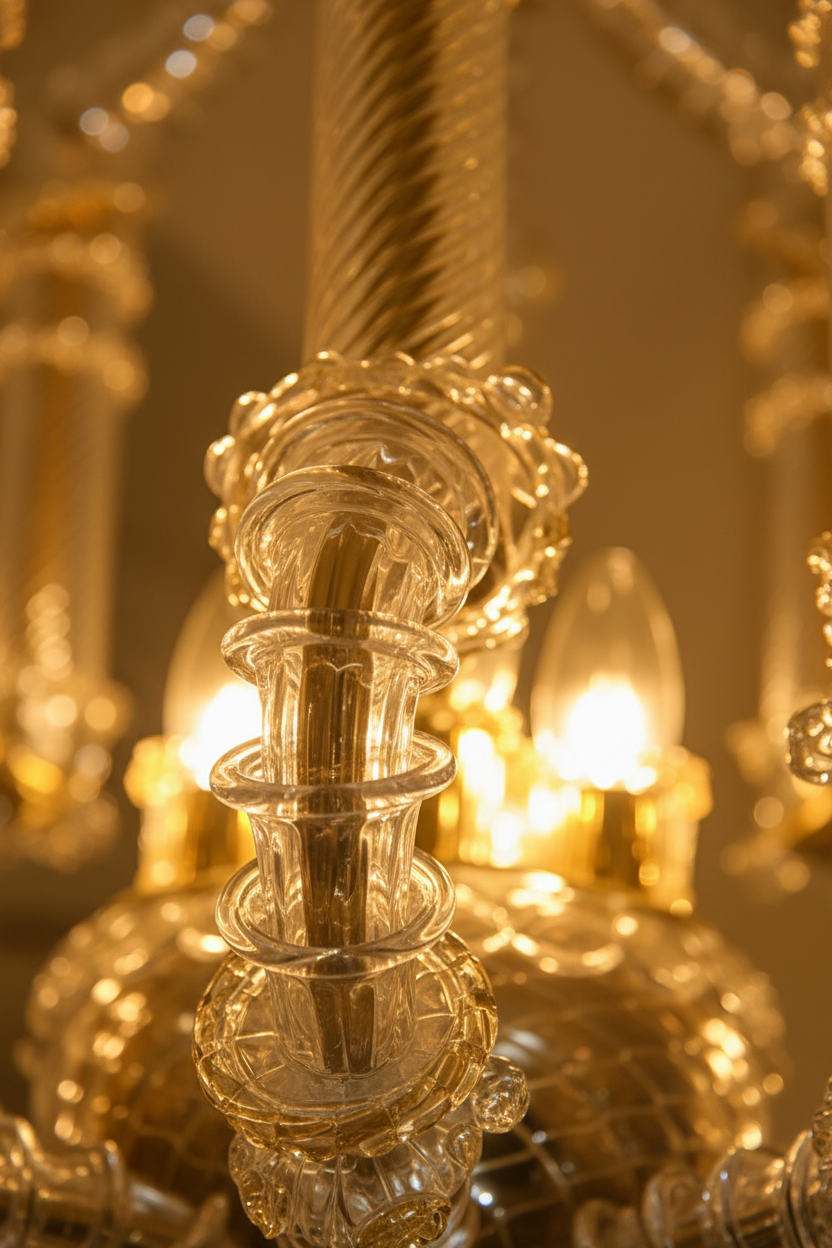
Bespoke design and custom decor: chandeliers, rugs, mirrors and wallpaper created for your project. From concept to finished piece, with Italian artisans.