

Your cart is empty
Tax included and shipping calculated at checkout
Drawer menu
Tax included and shipping calculated at checkout
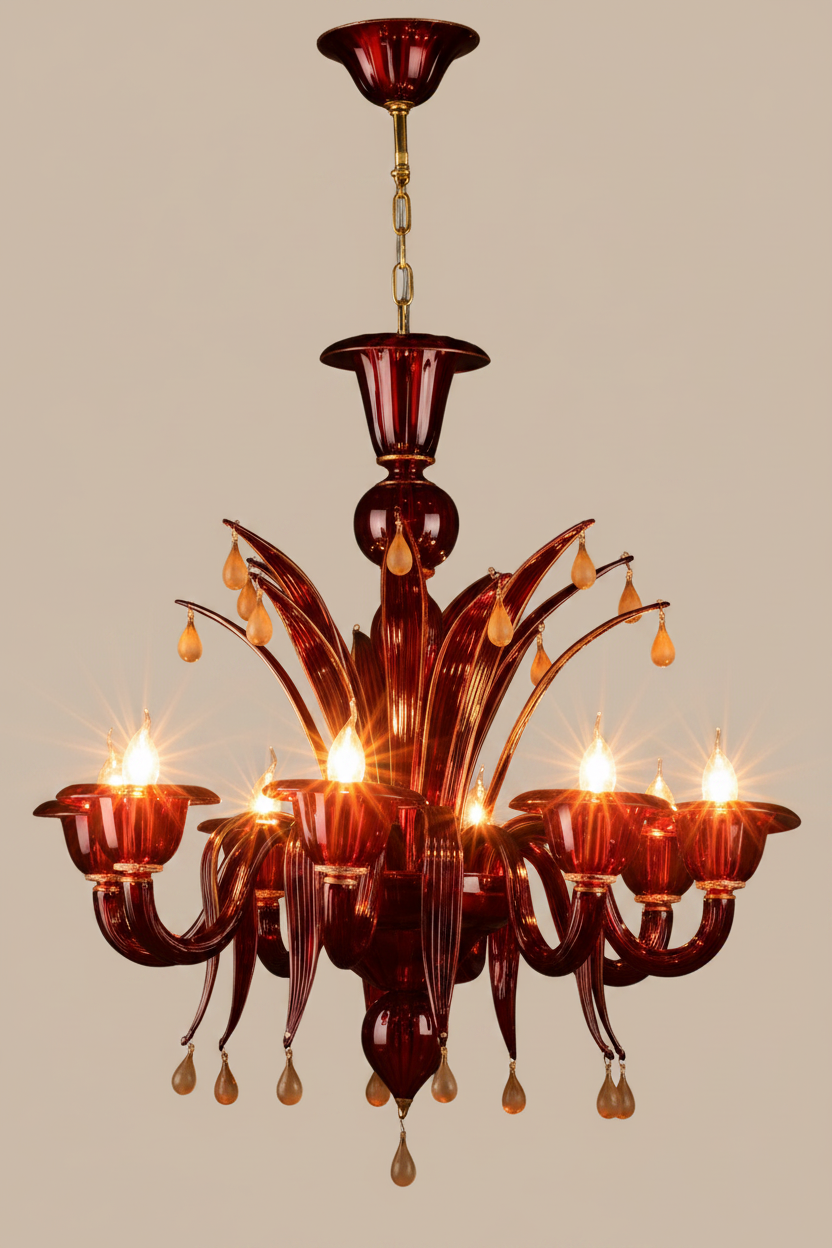

Every year, millions of objects labelled "Murano glass" are sold around the world. Most of them have never been near the island of Murano.
This is not a minor detail. It is the central problem of an entire industry and the reason why, at Murano Shutters, authenticity is not a marketing claim but a structural commitment, documented and verifiable.
If you are considering a Murano glass chandelier, a sconce, a vase or a decorative object for a significant interior, understanding what separates genuine Murano glass from an imitation will protect your investment and your project.

Murano is a small archipelago of islands in the Venetian Lagoon, approximately one mile north of Venice. Glassmaking has been practised there continuously since 1291, when the Republic of Venice ordered all glass furnaces to relocate from the city to the island, partly to reduce the fire risk in Venice, and partly to protect the trade secrets of the master glassmakers.
For more than seven centuries, the island has been the sole global centre for a specific category of artistic glass production. The techniques; soffiatura a bocca, filigrana, reticello, lattimo, pulegoso, murrina millefiori, poliedri; were developed, refined and passed down exclusively within Murano's master workshops.
Authentic Murano glass is not a style. It is a place of origin and a living craft tradition.
A chandelier produced in a Chinese factory using coloured glass and chrome fittings is not Murano glass, regardless of what the label says. The difference lies not only in where the object was made, but in how it was made; individually, by hand, by a master glassmaker (maestro vetraio) who learned from a master before him.
Certification
In 1994, the Consorzio Promovetro Murano, the official consortium of Murano glassmakers; established the Vetro Artistico® Murano trademark.
This is the only legally recognised certification that guarantees:
The Vetro Artistico® Murano mark is not decorative. It is a legal instrument, its misuse constitutes trademark infringement under Italian and European law.
All Murano glass pieces sold by Murano Shutters carry the Vetro Artistico® Murano certification or are accompanied by verifiable documentation of their Murano origin. This is non-negotiable.

You may be wondering how to tell a real piece from an imitation when buying online or from a gallery. Here are the signals that matter.
Genuine pieces carry a holographic sticker with the Vetro Artistico® Murano mark, a registration number, and the name of the producing workshop. If there is no label; or if the label lacks these details; the piece's origin cannot be guaranteed.
Authentic mouth-blown Murano glass is never perfectly uniform. Slight variations in thickness, micro-bubbles trapped in the glass, natural gradients in colour saturation, and minor asymmetries in shape are not defects. They are the direct imprint of the human hand and the most reliable sign that a piece was made the way it claims to be. Factory-produced glass, by contrast, is uniform and flawless in ways that handcraft cannot be.
Hand-blown Murano glass has a specific density and surface quality that is difficult to replicate industrially. Hold a piece: it has a presence, a solidity, a slight irregularity of surface that machine-made glass lacks.
Every genuine Murano piece can be traced back to its originating fornace (glassblowing furnace). At Murano Shutters, we know exactly which workshop produced each piece we sell. If a seller cannot tell you who made a piece and where, that is a significant warning sign.
Authentic Murano glass is expensive to produce. A genuine hand-blown chandelier with twenty or thirty individually blown elements, assembled by a master glassmaker on the island of Murano, cannot retail at the price of a mass-produced fitting. If the price seems implausibly low for what is described, it almost certainly is.
Imitation problem
The scale of the counterfeit Murano glass market is well documented. The Consorzio Promovetro Murano has been fighting fraudulent use of the "Murano glass" label for decades, in Italian courts, before the European Commission, and in international trade disputes.
The problem is systemic: the name "Murano glass" has no protected geographical indication (PGI) status under EU law, which means any manufacturer anywhere in the world can legally use the term on a product that has never been within a thousand miles of Venice. Only the Vetro Artistico® Murano trademark; a registered private mark, not a geographic indication, provides enforceable legal protection.
This is precisely why the certification matters, and why we place it at the centre of everything we do.

Part of what you are acquiring when you buy a genuine Murano glass piece is a connection to one of the longest uninterrupted craft traditions in Europe.
The techniques used today in Murano's fornaci are the same techniques that shaped the golden age of Venetian glassmaking, the period, spanning from the fifteenth to the seventeenth century, when Murano supplied courts, cathedrals and palaces across the entire known world.
They are also the techniques that defined the design renaissance of the twentieth century, when masters like Napoleone Martinuzzi, Paolo Venini, Fulvio Bianconi and Tomaso Buzzi transformed the island's output into collector-grade design objects; works that now occupy the permanent collections of the world's leading design museums.
A single glassblower, using only a long metal pipe and his breath, shapes molten glass at temperatures exceeding 1,800°F (1,000°C). Each shape is unique. No two pieces are identical.
Thin rods of coloured glass are fused into the molten mass and manipulated to create the intricate lattice patterns that define Venetian glassmaking at its most technically demanding.
An opaque white glass, developed in Murano as an early attempt to replicate the appearance of Chinese porcelain. Still produced by a handful of Murano workshops using centuries-old formulas.
A technique that traps controlled air bubbles within the glass during the blowing process, creating a distinctive textural effect.
Multi-faceted geometric glass elements that refract light with exceptional intensity, characteristic of both classic Rezzonico chandeliers and mid-century modern design.
Cross-sections of patterned glass rods, fused and reworked to create the intricate floral or geometric mosaic patterns associated with Murano at its most decorative.
Each of these techniques requires years; sometimes decades, of training. They cannot be learned from a manual or reproduced by a machine. They exist because a community of craftspeople on a small island has chosen, generation after generation, to preserve them.

Purchasing a genuine Murano glass piece for a significant interior is not purely an aesthetic decision. It is a decision about quality, longevity and the kind of value an object carries over time.
A certified Murano glass chandelier or sconce is, by definition:
For interior designers and architects working on significant residential or hospitality projects, this traceability also functions as a design credential: the ability to specify, in a project brief or a presentation, that every glass element is certified Venetian handcraft.
We work directly with master glassblowers and workshops on the island of Murano. Every piece in our collection; chandeliers, sconces, ceiling lights, floor and table lamps, vases, centrepieces, is sourced from Murano fornaci whose work we know and whose output we can guarantee.
The Vetro Artistico® Murano certification and the Consorzio Promovetro Murano are not badges we display for marketing purposes. They are the minimum standard below which we will not work.
If you have questions about the origin or certification of any specific piece, we will answer them directly with documentation, not with assurances. + 39 3209206347


Access to the Private Collections is available by request only.
Interior designers, architects, and private clients are invited to contact our studio to:
Each inquiry is personally reviewed by our studio.
Request Private Access
Contact the Studio


Some creations are meant to be discovered only by those who seek them.
The Private Collections represent the most intimate expression of Murano Shutters ... where design meets discretion.
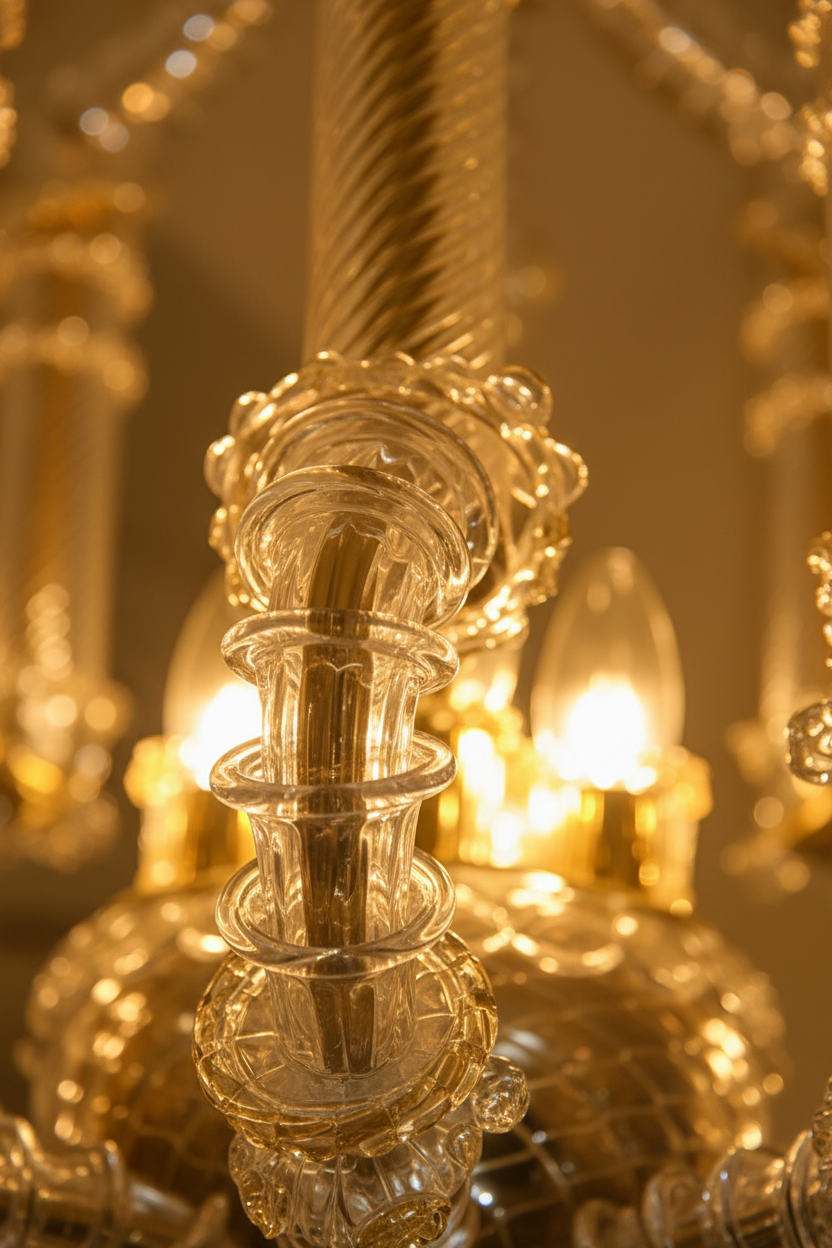
Bespoke design and custom decor: chandeliers, rugs, mirrors and wallpaper created for your project. From concept to finished piece, with Italian artisans.


