
Your cart is empty
Tax included and shipping calculated at checkout
Bespoke solutions for interior designers and exclusive projects
Drawer menu
Drawer menu
Tax included and shipping calculated at checkout

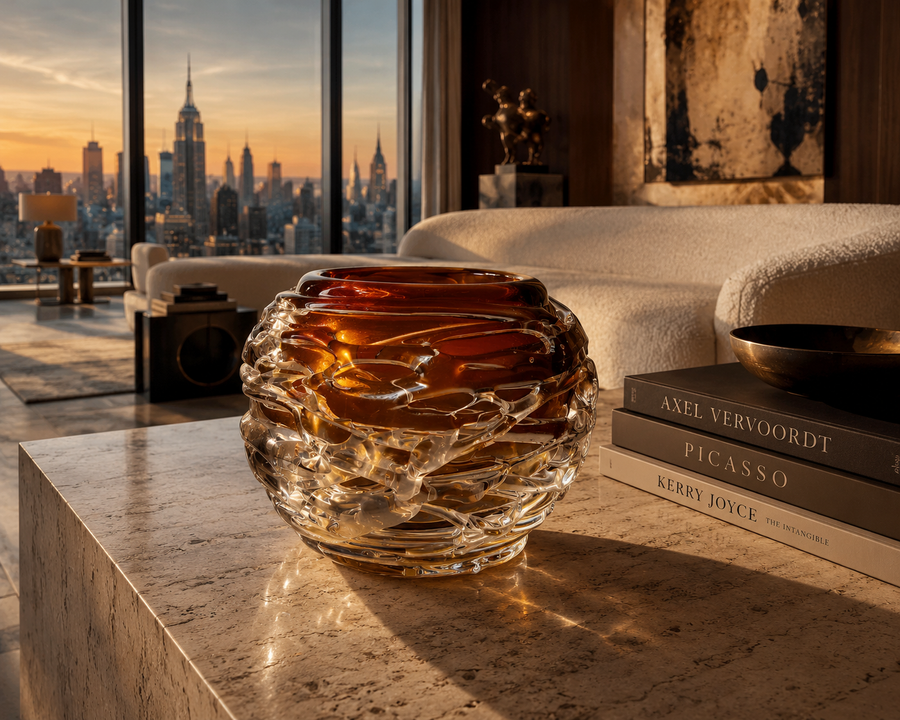
Vintage Murano vases are among the most sought-after decorative objects in the world of luxury collecting and interior design. Each piece carries decades of craft history, the unmistakable mark of the Venetian glass masters who made it, and that extraordinary ability to transform molten glass into something you could genuinely call inhabitable sculpture. These are not simply decorative objects: they are material testimonies of a centuries-old knowledge whose beating heart has always been the island of Murano.
Perhaps you have come across a vintage Murano glass vase in a gallery, in a beautifully designed home, or while leafing through an international auction catalogue — and found yourself wondering what makes these pieces so fundamentally different from anything else produced in glass anywhere in the world. The answer lies in technique, history, and the cultural identity that each piece carries within itself. On this page you will find everything you need to understand, identify, and choose an authentic vintage Murano vase — and to discover the selection we have carefully put together for you at Murano Shutters.


There is something immediately recognisable about a vintage Murano glass vase. Light passes through it differently from any other object: the colours seem to have an internal depth, almost as if they were alive. This is not a coincidence — it is the direct result of craft techniques developed on the island of Murano over more than seven hundred years of uninterrupted glassmaking tradition.
A vintage Murano vase is not simply a decorative vessel. It is a unique piece, entirely mouth-blown by a glass master who spent years — often decades — mastering techniques handed down from generation to generation. Every variation in colour, every irregularity in the surface, every air bubble trapped within the glass is not a flaw: it is the signature of the human hand, the tangible mark of authentic craftsmanship.
Unlike an industrially produced object, a vintage Murano glass vase carries a precise story within it: the story of the furnace where it was created, the master who worked it, and the historical and stylistic moment it belongs to. This is why private collectors, interior designers, and architecture studios around the world continue to seek them out with growing attention.
The twentieth century represents the golden age of Venetian art glass. Between the 1930s and the 1970s, the great Murano manufacturers went through an extraordinary season of experimentation, driven by collaboration with some of the most important Italian designers and architects of the century.
Names like Fulvio Bianconi, Flavio Poli, and Ercole Barovier completely redefined the concept of the glass vase: no longer a simple functional object, but sculpture, formal research, a dialogue between art and craft. It is in this context that the techniques and visual languages we now recognise as characteristic of the vintage Murano vase of the 1950s, 1960s, and 1970s were born.
The mid-century Murano glass season is today the subject of study in international design museums and institutions, from the Venice Biennale to the Museum of Arts and Design in New York. And the pieces produced in that period continue to be among the most contested in the luxury modernariato market.
At this point, you are probably asking yourself: what concretely sets a vintage piece made in Murano apart from any other object in blown glass? The answer lies in the techniques — some of which have remained essentially unchanged for centuries.
The starting point for any Murano glass vase is soffiatura a bocca — mouth-blowing. The glass master collects a precise quantity of molten glass from the furnace, places it at the end of a metal blowpipe, and begins to blow, shaping the form through a combination of lung power, rotation, and specific tools.
This technique requires an almost athletic coordination and a material sensitivity that can only be acquired through years of intensive practice. Each working session takes place at temperatures above 1,800°F (1,000°C), which means the master has a very limited time window to shape the glass before it solidifies. It is this urgency, this precision in action, that makes every piece unrepeatable.
The technical vocabulary of Venetian art glass is extraordinarily rich, and many of its most evocative words belong precisely to the vintage period we are exploring here.
Pulegoso is a technique that deliberately introduces air bubbles into the glass during working, creating a surface with a raw, intentionally imperfect appearance that catches the light in an irregular and evocative way. It is one of the most characteristic techniques of Murano vases from the 1950s and 1960s.
Lattimo is a milky white glass, obtained by adding tin oxide to transparent glass. It is frequently combined with other colours to create layering and contrast effects that became genuine stylistic codes of the great 20th-century manufacturers.
The sommerso technique involves the immersion of a layer of coloured glass inside an outer transparent layer, creating an internal chromatic depth that seems to emanate from the very heart of the piece. Many of the most sought-after vintage vases among contemporary collectors are made using this technique.
Filigrana — preserved untranslated in the international design vocabulary — is perhaps the most virtuosic technique of all: it consists of incorporating coloured glass threads within the blown mass, creating geometric or spiral patterns of extraordinary precision.
The island of Murano is not simply a geographical place: it is a cultural and craft ecosystem unlike anything else in the world. Since 1291, when the Republic of Venice required all glassmakers to relocate to the island for fire safety reasons, Murano has been the world capital of glassmaking art.
The Venetian glass masters who work there hold a technical knowledge that is transmitted within families and workshops, often from father to son, with a continuity that has no equal in any other sector of Italian artistic craftsmanship. It is thanks to this uninterrupted transmission that today it is still possible to find craftsmen capable of replicating — or rather reinterpreting — the techniques that made the great vintage vases of the 20th century famous.
If you truly want to understand the value of a vintage Murano vase, you cannot do without knowing the key figures who wrote the history of this field.
Fulvio Bianconi is perhaps the most iconic name in post-war Murano glass. His collaboration with the Venini manufactory, which began in 1946, produced some of the most revolutionary forms in 20th-century Venetian art glass: the "Pezzato" vases with their geometric colour fields, the "Fazzoletto" with its soft and apparently casual form, the "Commedia dell'arte" series that transformed glass into narrative. His pieces are today held in the permanent collections of the world's leading design museums.
Flavio Poli, designer and artistic director of Seguso Vetri d'Arte, brought the sommerso technique to levels of sophistication never previously achieved. His vases from the 1950s — with their clean colour fields, essential forms, and internal chromatic depth — perfectly embody the dialogue between Venetian craftsmanship and international modernism.
Ercole Barovier represents instead the continuity of the great Murano family tradition. As artistic director of Barovier & Toso, he developed personal techniques such as barbarico and primavera, which became immediately recognisable stylistic hallmarks and are today particularly sought after in the collectors' market.
A vintage Murano glass vase has a dual nature: it is a decorative object of extraordinary beauty, but it is also an asset that tends to appreciate over time. Pieces signed by the great 20th-century masters have reached, in recent international auctions, prices that reflect growing demand and a structurally limited supply.
Pieces without precise attribution but with documented craft quality follow the same trend, especially when acquired through qualified channels with provenance certification. For an attentive interior designer or collector, a well-chosen vintage Murano vase is not an expense: it is an investment in beauty that has every characteristic to hold and grow in value over time. For private collectors in search of particularly significant pieces, our Private Design Collections offer an exclusive and reserved selection, available on direct request.
The strength of a vintage Murano vase in a contemporary context lies precisely in the generative contrast it creates with modern spaces. A pulegoso vase from the 1960s, with its material texture and intense colour, dialogues beautifully with neutral surfaces, natural materials, and clean-lined furniture.
A lattimo vase from the 1950s, with its luminous whiteness, can become the focal point of a minimalist space or the touch of light in a deep-toned interior. Filigrana vases, with their decorative complexity, require more visual space around them but deliver a scenographic presence that is difficult to replicate with any other furnishing element.
A small secret: the best interior designers treat vintage Murano glass vases exactly as they would treat a work of art on paper or canvas — as pieces that structure space, create visual hierarchy, and tell a precise story to the visitor. Paired with Venetian mirrors or antique Venetian mirrors from the same period, Murano vases create a coherent visual narrative that few other materials can match.
The selection of vintage Murano vases available at Murano Shutters is the result of a research and curation process that starts directly on the island of Murano, where our operational warehouse allows us to work in close contact with historic furnaces and local collectors.
The market for antique Murano vases and vintage pieces does not interest private collectors alone. In recent years, demand from the world of interior design and interior architecture has grown significantly, driven by a rediscovery of Italian modernism and the desire to integrate into contemporary spaces pieces that carry a precise history and identity.
Murano Shutters works directly with architects and interior designers, offering a dedicated B2B service that includes access to the vintage selection, project-specific sourcing consultancy, and the possibility of bespoke commissions through our bespoke design service.
For contract and hospitality projects — luxury hotels, restaurants, wellness spaces, high-end private residences — we offer dedicated pathways that integrate vintage sourcing with the production of new pieces inspired by the stylistic languages of 20th-century Murano.
Beyond the selection of authentic vintage pieces, Murano Shutters offers the possibility of commissioning new Murano glass vases inspired by the stylistic languages of the 20th century — with techniques such as pulegoso, lattimo, sommerso, and filigrana replicated by the Venetian glass masters we collaborate with on the island.
This option is particularly appreciated by interior designers and architects looking for a piece with a vintage aesthetic but with specific dimensions, colours, or technical combinations that available vintage pieces on the market cannot meet. For requests of this kind, our custom chandeliers service and our Murano glass authenticity page are the ideal starting points.
You can also find inspiration by exploring our vintage Murano chandeliers, vintage Murano sconces, and vintage Murano lamps collections, to build a coherent selection of vintage Venetian art glass for your project.
Please note: not every vintage Murano vase carries the signature of a celebrated master or the mark of a historic manufactory. There is a broad body of vintage production of great craft quality that is correctly described as made in the manner of a particular manufacturer or designer.
This designation does not diminish the value of the piece: it simply indicates that the vase was made by qualified Murano craftsmen using techniques and stylistic languages characteristic of a specific period or school, without it being possible to attribute authorship to a precise individual. It is a common and respected practice in the vintage glass market, and many of the most interesting pieces — also in terms of quality-to-price ratio — belong precisely to this category.
This is probably the most frequently asked question among those approaching the world of vintage Murano glass for the first time. And the answer, unfortunately, is not always straightforward: the market is populated by replicas and imitations that can deceive even an experienced eye.
The main reference point for the authenticity of glass produced on the island is the Consorzio Promovetro Murano, which protects and promotes authentic Murano glass production through the registered trademark Vetro Artistico® Murano.
This mark — applied as a label or engraving — certifies that the piece was genuinely produced on the island of Murano by qualified craftsmen, in accordance with traditional techniques. For vintage pieces, this mark may naturally be absent: it was formally introduced in the 1990s, so older pieces lack it for chronological reasons, not for any lack of authenticity. You can explore all the elements that certify the origin of a piece on our dedicated page on Murano glass authenticity.
For a vintage Murano vase predating the 1990s, the key authenticity elements to verify are:
The decorative glass market offers an enormous quantity of objects that visually evoke the vintage Murano vase without being either authentic or produced in Murano. Some come from the Czech Republic, others from China, others still from Italian furnaces located outside the island.
The most obvious differences, for those who know what to look for, concern the weight of the glass — authentic pieces tend to be heavier than expected — the quality of the colour, which in original pieces has a depth and saturation that is very difficult to replicate industrially, and the presence of those small imperfections that are the unmistakable sign of hand working. A piece that is too regular, too perfect, should raise questions.
Every piece in our Murano glass vases collection is personally selected, technically verified, and documented in its provenance before being listed in the catalogue. We operate with the same care we would bring to acquiring a work of art, because that is precisely what these pieces are.
Our commercial base in Los Angeles and our operational warehouse in Murano allow us to manage international shipments with the care and security that objects of this kind require. Every vase is individually packaged with materials specifically designed for the protection of art glass and shipped with insurance coverage appropriate to its value.
Explore also our Murano glass centerpieces to complete your selection of vintage Venetian art glass.
The value of a vintage Murano vase depends on several factors: attribution to a master or historic manufactory, period of production, technique used, the conservation condition of the piece, and available provenance documentation. Pieces signed by the great 20th-century masters — Bianconi, Poli, Barovier — reach prices at international auctions ranging from several thousand dollars to tens of thousands for the most significant examples. Pieces without precise attribution but with documented craft quality generally sit in a more accessible bracket, while retaining considerable aesthetic and cultural value.
Cleaning a vintage Murano glass vase requires care and delicacy. The safest method is hand-washing with warm water and a neutral detergent, absolutely avoiding the dishwasher, whose thermal variations and aggressive detergents can irreversibly damage the surfaces and colours of art glass. For pieces with 24k gold decoration or particularly delicate layering techniques, it is advisable to limit cleaning to a soft dry or lightly dampened cloth. Ideal conservation involves controlled humidity environments, away from direct heat sources and surfaces that could cause knocks or vibrations.
Yes, absolutely. Murano Shutters collaborates with Venetian glass masters on the island of Murano who are able to create new pieces using the historic techniques of the 20th century — mouth-blowing, pulegoso, lattimo, sommerso, filigrana — with results of the highest craft level. For bespoke commissions, we invite you to reach out through our bespoke design page or directly by email at store@muranoshutters.com, specifying your requirements in terms of dimensions, techniques, colours, and stylistic references.
Final thoughts
By this point you have all the elements to understand why vintage Murano vases hold a truly singular place in the landscape of luxury decorative objects.
To summarise the key points:
Explore our selection or contact us for a personalised consultation: we are available for a direct and confidential conversation, whether you are a private collector, an interior designer, or an architecture studio looking for the right piece for your project.
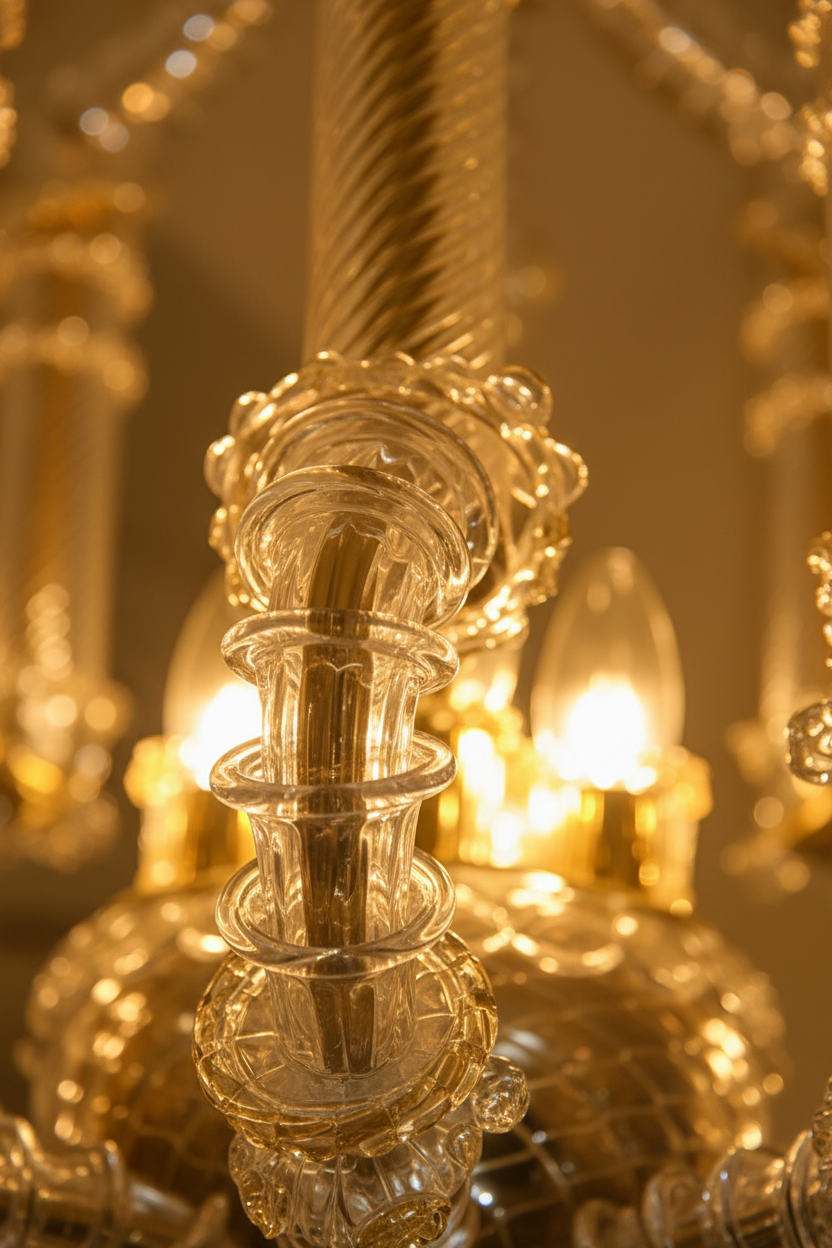
Bespoke design and custom decor: chandeliers, rugs, mirrors and wallpaper created for your project. From concept to finished piece, with Italian artisans.