
Your cart is empty
Tax included and shipping calculated at checkout
Bespoke solutions for interior designers and exclusive projects
Drawer menu
Drawer menu
Tax included and shipping calculated at checkout

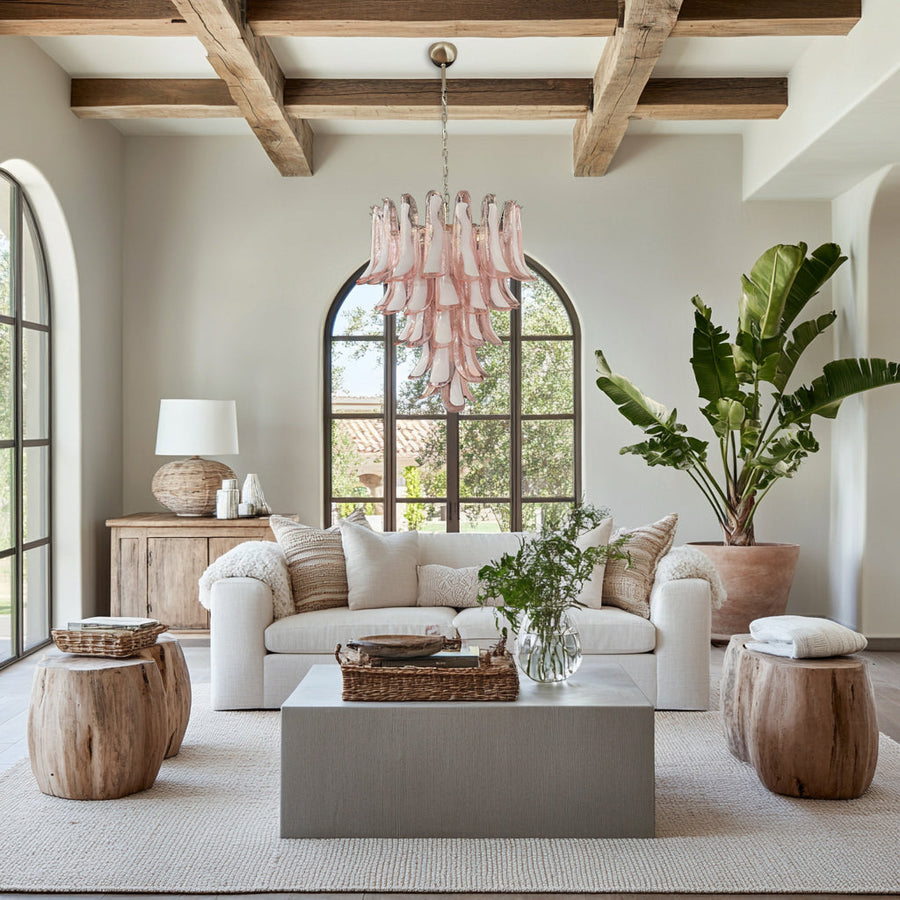
If you are looking for authentic vintage Murano chandeliers, mouth-blown by Venetian master glassmakers and capable of radically transforming any space, you are in the right place.
These pieces are not simply lighting objects. They are fragments of history, born on the island of Murano from hands that have passed down the same technique from generation to generation, and that continue today to produce unrepeatable works exactly as they did in the 1950s, 1960s, and 1970s.
The vintage Murano chandeliers in the Murano Shutters collection are crafted using mouth-blown glass according to ancient Venetian traditions, certified by the Vetro Artistico® Murano trademark, and designed for those — interior designers, architects, or private collectors — who are looking for something that industrial production can never offer: a unique, unrepeatable piece with a story to tell. If you want to explore the full range of Venetian lighting, you can start from our collection of Murano chandeliers for a complete overview of what we offer.
In this page you will discover:
Few periods in the history of Italian design have left an imprint as enduring as the one stretching from the 1950s through the 1970s.
During those years, something extraordinary was taking shape on the island of Murano.
The introduction of electric lighting — which had happened in the preceding decades — had already freed the master glassmakers from the practical constraints of wax candles, opening creative horizons that Venetian craftsmanship had never explored before. With electric light, glass stopped being merely a diffuser and became the absolute protagonist: every bubble, every chromatic nuance, every irregular geometry could be valorized in a completely new way.
In the 1950s, the dialogue between the organic forms of the postwar period and the rigorous geometries of the following decade produced a generation of Murano chandeliers capable of embodying both lightness and formal solidity. Then came the 1960s, and mid-century modern design brought with it a new ambition: objects that spoke of the future, of space, of modernity, without turning their backs on artisan tradition. The 1970s, finally, consecrated the space age style, and with it the great sculptural compositions, the bold volumes, the experimental chromatic palettes — from deep amber to fumè, from pure crystal to milky lattimo.
Masters such as Gio Ponti, Carlo Scarpa, and Tomaso Buzzi had already traced the lines of an aesthetic that the Venetian manufacturers knew how to interpret with a formal freedom that was extremely rare in the international design landscape. It is in this cultural context that the pieces we now call vintage Murano chandeliers were born: not objects of fashion, but material testimonies of an unrepeatable moment in the history of Italian design.
Among the Venetian manufacturers that helped build the aesthetic of vintage blown glass, two names above all entered the collective memory of international design: Mazzega and Vistosi.
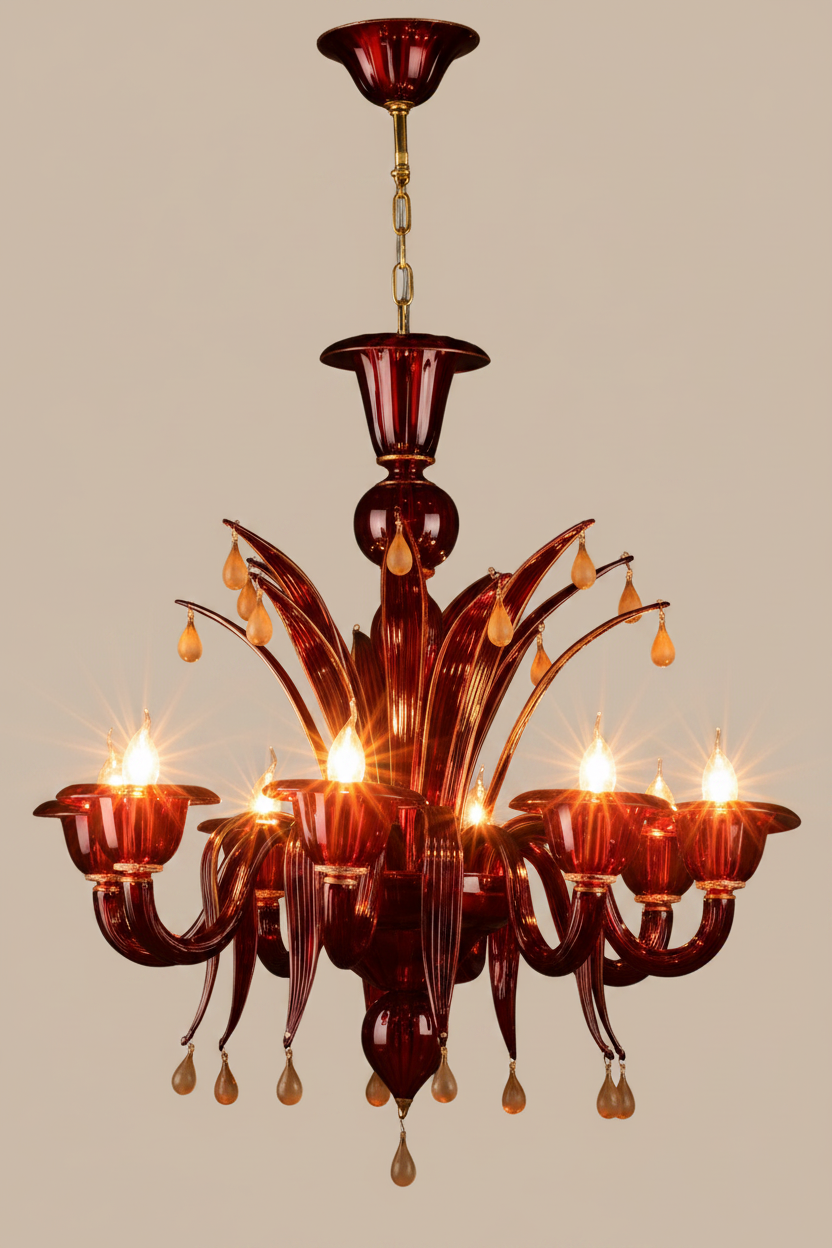
Mazzega-style chandeliers are recognizable for their organic and sculptural forms, for the large blown-glass corollas that capture light with a visual intensity that is difficult to replicate. The use of color was bold and deliberate: deep amber, bottle green, layered fumè — every shade was chosen to dialogue with the metal frame and amplify the overall luminous effect.
Vistosi-style chandeliers, on the other hand, pursued a more geometric and rational formal research. The polyhedral forms, precise and cut volumes, the preference for crystals that multiply and refract light in thousands of different directions: this is the aesthetic identity that made Vistosi an indispensable reference for anyone wanting to understand where the roots of vintage Venetian design lie.
Today, the Murano Shutters collection draws direct inspiration from this heritage, producing pieces in the manner of these great manufacturers with the same techniques, the same materials, the same artisan attention — but with the total customization possibilities that only a contemporary workshop can offer.
One of the aspects that makes vintage Murano chandeliers absolutely unrepeatable is the variety and complexity of the glass forms that compose them. Every element is individually mouth-blown by the master glassmaker, then assembled by hand into compositions that can count dozens — sometimes hundreds — of single pieces.
It is this multiplication of the individual element that creates the visual magic of these chandeliers: light does not pass through a single surface, but fragments through a constellation of forms, generating refraction effects impossible to achieve with any other material or technique.
Among the most iconic forms of vintage Murano glass, poliedri chandeliers hold a place of honor.
These are geometric elements with a hexagonal cross-section, mouth-blown and then hand-finished, whose multi-faceted surface captures and refracts light with a prismatic effect of extraordinary intensity. Each poliedro is slightly different from the next — this is the fundamental characteristic of mouth-blown glass — and it is precisely this controlled irregularity that creates the variation of living, pulsating light that no industrial production can ever replicate.
The triedri and quadriedri take this principle even further: crystal prisms with three or four points, cut at the lower end with a precision that seems almost incompatible with the artisan nature of the production process. In the great spiral compositions — those that closely recall the aesthetic of Sputnik chandeliers and that made the fortune of Venetian design in the 1960s and 1970s — the quadriedri arrange themselves in ascending sequences that create a hypnotic visual movement, as if the chandelier were in constant rotation even when still.
The result, in the illuminated room, is a cascade of reflections that moves with the natural and artificial light, turning every wall, every ceiling, every nearby surface into an active part of the luminous composition.
Alongside the geometric forms, the Venetian tradition has developed a repertoire of organic forms equally recognizable and fascinating.
The tubi stella — also called tronchi in the jargon of the Murano furnaces — are elements characterized by an irregular surface and a star-shaped cross-section. Their irregularity is not a defect; it is the signature of the mouth-blowing process: each tube carries the unique marks of the glassmaker's breath, the temperature of the furnace, the speed of rotation of the mold. Grouped in large compositions, tubi stella create visually complex effects, with a luminous vibration that changes completely depending on the angle and intensity of the light source.
The fiori calla — blown glass stems with a flower-shaped opening — introduce a botanical and organic dimension that was enormously successful in the aesthetics of the 1970s and 1980s, when Italian design looked to nature as its primary source of formal inspiration. Each calla is blown separately, with a long and slender stem that opens at the upper end into a crown of thin, translucent petals, capable of diffusing light in a soft and enveloping way.
The clavette, finally, are long drops of Murano glass that hang as pure decorative elements. Their simple, elongated form makes them elements of great formal elegance, perfect for vertical compositions or for adding movement to more linear and geometric structures.
The forms are only half the story. The other half is told by the material, in its chromatic and tactile expression.
Pulegoso is one of the most fascinating glass types in the entire Murano tradition: it is a glass with microscopic air bubbles incorporated into the mass, which create an irregular surface texture and a luminous effect similar to that of a liquid in motion. Each bubble captures light differently, generating a visual vibration of great depth that changes completely depending on the observer's position and the quality of available light.
Lattimo — from the Latin lac, milk — is the opaque, luminous white that characterizes some of the most refined vintage productions. It is not a flat white: it is a white that absorbs and returns light with an almost luminescent softness, reminiscent of Venetian marbles and the great classical chandeliers of patrician palaces. Used in combination with crystal or amber elements, lattimo creates contrasts of extraordinary elegance.
Fumè — smoky gray, transparent yet veiled — is the choice for those who want depth and mystery. It is the glass that transforms a chandelier into a powerful scenic presence, suited to spaces of great visual impact such as hotel lobbies, formal dining rooms, and monumental entrance halls.
Filigrana and reticello — glassworking techniques that insert white or colored glass filaments within the transparent mass — add a further layer of visual complexity, with geometric or floral patterns that appear suspended inside the glass as if etched from within.
A vintage Murano chandelier is not a neutral element. It is an absolute protagonist that requires the right space and context to express its full visual potential.
That said, the versatility of these pieces is far greater than one might imagine: the same geometric form can work perfectly in both a classical interior and a contemporary minimalist environment, provided that certain fundamental proportions are respected.
The most natural environments for vintage Murano chandeliers are those where a high ceiling allows the composition to breathe and the distance from the light source amplifies the refraction effects on the floor and walls.
A monumental entrance hall, a reception room with four-meter ceilings, a double-height staircase: these are the contexts where a large vintage Murano chandelier — perhaps inspired by Mazzega compositions or the quadriedri spirals of the 1970s — becomes the true gravitational center of the entire interior.
This is not just about lighting. It is about a statement piece that defines the aesthetic identity of the entire residence, communicating a precise cultural choice: a preference for authentic craftsmanship, for the history of Italian design, for the quality of materials that age well and become more beautiful with the passing of time.
For more intimate settings — a formal bedroom, a private dining room, a study — more compact models with poliedri or lattimo offer an equally sophisticated effect, with a calibrated scenic presence that does not overwhelm the space but enriches it with discretion.
In the contract and hospitality sector, lighting is never merely functional: it is an integral part of the experience that a property wants to offer its guests.
A boutique hotel that chooses classic Murano chandeliers or vintage Murano chandeliers for its common areas — lobby, in-house restaurant, signature suites — is communicating something precise: an idea of luxury expressed not through quantity, but through material quality, history, and artisan authenticity.
This is precisely the kind of narrative luxury that international travelers seek increasingly, tired of standardized large hotels and drawn instead to properties that tell a story through every detail.
Murano Shutters has extensive experience in contract and hospitality projects, with the ability to supply coherent pieces for entire spaces — same style, same chromatic palette, same dimensions calibrated to ceiling heights — guaranteeing aesthetic continuity without sacrificing the artisan uniqueness of each individual piece.
One of the most interesting insights in contemporary design is that vintage Murano chandeliers work magnificently also — and sometimes especially — in modern and minimalist environments.
The contrast between the geometric purity of a contemporary interior and the organic complexity of a large blown glass chandelier creates a positive visual tension that brings life and depth to the space. The mistake to avoid is thinking that vintage must always accompany vintage: often a Mazzega chandelier or a composition of crystal poliedri against a minimal white backdrop has a greater visual impact than any contemporary lighting solution.
The rule, if one exists, is a single one: the piece must have enough space around it to breathe, and the light — both natural and artificial — must be able to interact directly with the glass surfaces without obstruction.
Murano Shutters Inc. is a company with a dual geographical identity that perfectly reflects its philosophy.
Production takes place on the island of Murano, where Venetian master glassmakers work with the same techniques passed down through generations, in furnaces that operate according to the rhythms and methods of the great Venetian tradition. The commercial headquarters is in Los Angeles, the heart of North American international luxury design, from where the brand manages relationships with interior designers, architects, and private collectors around the world.
This positioning is not accidental: it means that every vintage Murano chandelier that leaves Murano reaches its final recipient with all the logistical care and attention to detail that a piece of this value deserves, with custom-designed packaging to protect every individual glass element during international shipping.
It is a long journey, uniting two worlds — the Venetian lagoon and the hills of Hollywood — through the common thread of authentic artisan quality.
The bespoke customization of vintage Murano chandeliers by Murano Shutters starts from the premise that every interior design project is different from all others, and that a truly exceptional piece must be conceived for that specific space, not adapted after the fact.
On the chromatic front, the Murano master glassmakers are able to work with a virtually unlimited palette: from pure crystal to deep amber, from lattimo to fumè, from ruby red to cobalt blue, through to multicolor combinations where elements of different colors alternate in calibrated compositions. Each chromatic combination interacts differently with the artificial and natural light of the space, and this is a variable that our team is able to evaluate together with you before the piece is even created.
On the dimensional front, the custom vintage Murano chandeliers from Murano Shutters can be designed for ceilings of any height, with diameters and vertical development calibrated to the specific proportions of the space. This is particularly important in contract and hospitality projects, where standard dimensions often do not adapt to the architectural characteristics of the environments. Explore all the options available on the page dedicated to custom chandeliers.
Murano Shutters offers a dedicated trade channel for architecture studios, interior designers, and operators in the contract and hospitality sector who work on high-level projects.
Access to the trade channel guarantees reserved commercial terms, technical support during the specification and selection phase, production timelines agreed in accordance with project requirements, and the possibility of developing bespoke commissions with direct support from the production team in Murano.
If you are a design professional working on a project that calls for Murano glass chandeliers — residential, hospitality, or contract — visit the page dedicated to architects and interior designers to discover how we collaborate with design studios. Every inquiry receives personal attention, because we know that projects of this level require partners capable of responding with the same care and precision that we put into making the pieces.
One of the aspects that most clearly distinguishes Murano Shutters from competitors in this market segment is the ability to offer genuinely total customization on every piece — an approach that forms part of a bespoke design service that covers the entire decorative offering of the brand.
This is not about choosing between two or three predefined colors. It is about designing together a chandelier that does not yet exist, starting from the specific requirements of your project — the ceiling measurements, the chromatic palette of the interior, the number and position of the light points needed — and arriving at a unique piece that responds exactly to those requirements.
Few periods in the history of Italian design have left an imprint as enduring as the one stretching from the 1950s through the 1970s.
During those years, something extraordinary was taking shape on the island of Murano.
The market for Murano glass chandeliers is unfortunately full of imitations. Products manufactured industrially in Asia, with pressed glass and chemical colorants, are sold under vague denominations that evoke Venice without any legitimate claim to the name. Recognizing an authentic piece is essential, both for material quality reasons and out of respect for an artisan tradition that deserves to be protected and valued.
Vetro Artistico® Murano is the registered collective trademark managed by the Consorzio Promovetro Murano, the body that unites the glassworks of the island of Murano and that since 1994 has protected the authenticity and provenance of products made on the island.
Every piece bearing this trademark is certified as having been made on the island of Murano by qualified craftsmen, using materials and techniques consistent with the Venetian tradition. This is not a mere label: it is a formal guarantee that the piece you are purchasing was mouth-blown by a Murano master glassmaker, in one of the furnaces that have presided over that portion of the Venetian lagoon for centuries.
When you purchase a vintage Murano chandelier from Murano Shutters, you receive this guarantee as an integral part of your purchase: every piece is accompanied by documentation attesting to its origin and artisan production. To explore everything related to Murano glass authenticity and how to recognize an original piece, we have prepared a complete guide dedicated to this subject.
An authentic vintage Murano chandelier is made on the island of Murano using the mouth-blowing technique by certified master glassmakers, and carries the Vetro Artistico® Murano trademark with corresponding provenance documentation. Replicas — often manufactured industrially in Asia — are made with pressed glass, lacking the irregularities characteristic of hand-blown glass, and with flat colorations that do not have the depth and luminosity of authentic Murano glass. The difference is visible to the naked eye: mouth-blown glass has an internal vibration that pressed glass can never replicate.
The installation of a Murano glass chandelier requires a ceiling anchor point dimensioned for the weight of the piece — which can range from a few kilograms to over 66 lbs for the largest compositions. The wiring must be carried out by a qualified electrician, who will also verify compatibility with the building's electrical system. The Murano Shutters team provides all the technical documentation necessary for the correct installation of every piece.
More compact models — based on forms such as poliedri, lattimo, or clavette — adapt well to ceilings of standard height (9–10 ft), provided that a composition proportionate to the space is chosen. For very low ceilings, the optimal solution is to look at Murano ceiling lights, which maintain the artisan quality and vintage aesthetic with minimal vertical clearance.
Absolutely yes. Bespoke chromatic customization is one of the central services of Murano Shutters: the Murano master glassmakers are able to work with a very broad palette, including custom colorations developed on request to match the specific palette of an interior design project.
Production timelines vary depending on the complexity of the commission. For pieces from the standard collection, typical timelines are 4–6 weeks. For bespoke commissions with total customization — custom colors, dimensions, and configuration — timelines normally extend to 8–12 weeks, from the confirmation of the final design.
The choice that stands the test of time
At this point you have all the elements to assess whether a vintage Murano chandelier is the right choice for your project.
Let us recap the fundamental points:
There is only one thing left to do.
Explore the vintage Murano chandeliers collection and let yourself be inspired by the available pieces. If you are working on a specific project and need a bespoke solution, visit the page dedicated to custom chandeliers or contact the team directly through the architects and interior designers page.
Do you have questions about your project or want to understand which solution best fits your space? Write to us at store@muranoshutters.com : every inquiry receives personal and direct attention.
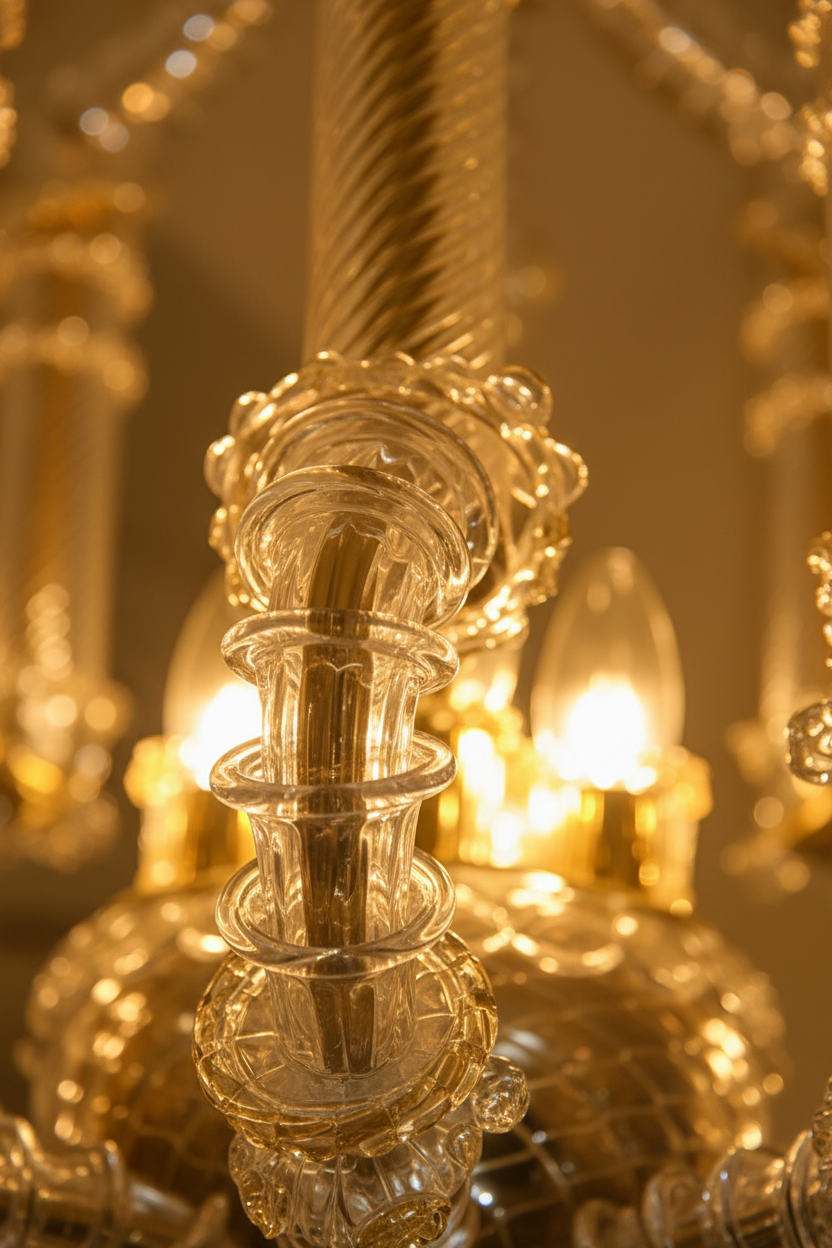
Bespoke design and custom decor: chandeliers, rugs, mirrors and wallpaper created for your project. From concept to finished piece, with Italian artisans.