
Your cart is empty
Tax included and shipping calculated at checkout
Bespoke solutions for interior designers and exclusive projects
Drawer menu
Drawer menu
Tax included and shipping calculated at checkout

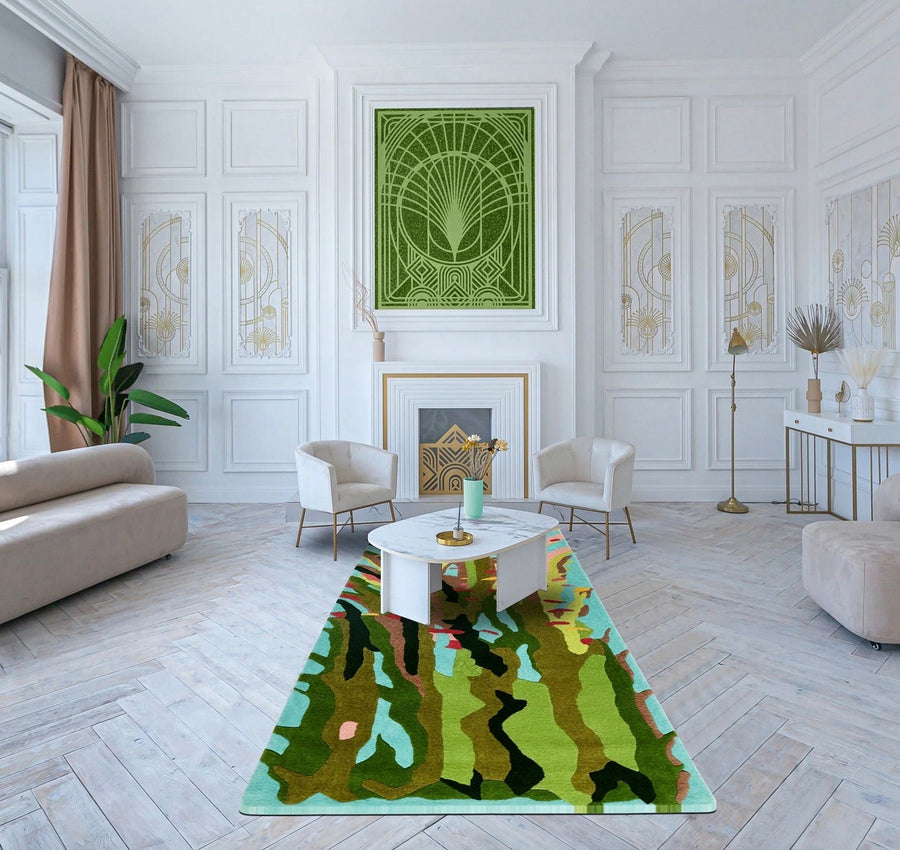
Picture four artisans bent over the same loom, for twelve weeks, repeating the same gesture millions of times. This is how hand-knotted rugs are born: not from a machine, not from glue, but from a craft passed down from generation to generation that no technology has ever managed to replicate. Anyone searching for fine rugs for an important interior project sooner or later ends up here, at the very top of the textile quality pyramid.
As you may well know, the market is flooded with products that all look alike. A hand-knotted rug, by contrast, is unique by definition: the pile is physically tied to the structure of warp and weft, knot after knot, with no adhesives and no industrial shortcuts. It's this invisible architecture that guarantees a lifespan measured in generations.
On this page you'll discover how a hand-knotted rug comes to life, what separates the different artisanal techniques, why it represents a true investment among luxury rugs, and how to choose one for every room. You'll also find our bespoke journey, designed for discerning private clients, architects and interior designers. Let's start from the beginning: from the knot.


Let's begin with the definition. Hand-knotted rugs are textile works in which every tuft of the pile is tied by hand to the rug's supporting structure, made of warp and weft, through a knot executed by the artisan. No glue, no mechanical insertion: only the physical compression of the weft against the knots holds the piece together, and this is precisely what makes it extraordinarily solid.
It sounds simple, put like that. In reality, behind every rug lie precise technical choices that determine its quality, definition and value. Let's look at them one by one.
The gesture is ancient and always the same. The artisan wraps the yarn around two adjacent warp threads (the vertical threads stretched on the loom), tightens the knot, cuts the yarn and moves on to the next one. Then again, and again, thousands, sometimes millions of times, row after row, until the design emerges from the loom like an image slowly developing.
Between one row of knots and the next, the weft is inserted: the horizontal thread that compacts the structure and locks every knot into its final position. This interplay of tensions is the secret of the rug's strength: the pile cannot slip out, because it is literally part of the rug's body.
You might be wondering how long all this takes. We'll tell you shortly, with real numbers.
Not all knots are equal, and here we enter territory that few people truly know. The two great families are the Persian knot (also called senneh, asymmetrical) and the Turkish knot (called ghiordes, symmetrical).
The Persian knot wraps around one warp thread and hooks onto the second, allowing higher density and finer, more detailed designs: it's the ideal choice for complex floral motifs and refined shading. The Turkish knot, sturdier, wraps around both warp threads and gives the pile superior compactness, perfect for the geometric patterns of the Anatolian and Caucasian traditions.
In short: the type of knot is the grammar with which the artisan writes the design. Knowing it helps you read a rug the way a connoisseur would.
Here's a detail almost nobody explains. Knot density indicates how many knots are present in a given unit of surface, and it's expressed in grades such as the 4/25 quality that characterizes some of our Oushak rugs in New Zealand wool.
The principle works exactly like the pixels of an image. The denser the knots, the sharper, more defined and more precious the design; fewer knots mean bolder motifs and more rustic textures (a stylistic choice, not necessarily a flaw). Density also affects timing: a finely knotted rug can require months of additional work compared to a coarser one of the same size.
Little secret: when evaluating a rug, turn over a corner and study the back. The regularity and tightness of the knots visible on the reverse tell you more about the quality of the piece than any label ever could.
Let's clear up a widespread misconception. The expression handmade rugs actually covers three very different techniques:
All clear so far? Good, because the difference is not academic: it changes the structure, the lifespan and the price positioning of the piece.
The hand-knotted rug remains the absolute benchmark for longevity and value. Its adhesive-free structure crosses the decades with the pile held firm, which is why it's the technique we choose for projects meant to last for generations.
Hand-tufting, for its part, is an excellent solution when a project calls for tighter timelines or particular textural effects (reliefs, varied pile heights, shaped outlines). It is still an artisanal process, executed by expert hands: it simply answers different needs. Unlike those who demonize one technique to glorify another, we prefer to tell you the truth: the right choice depends on the project, the budget and the time horizon you have in mind.
To this day, no machine exists that can reproduce a true hand-tied knot. Industrial production inserts the yarn mechanically or glues it to synthetic backings: over time, the fibers tend to loosen and the adhesives to crystallize and crumble.
A hand-knotted rug, by contrast, possesses a physical resilience measured in years. It withstands tension and crushing, and the natural memory of wool allows it to recover its original shape even after being compressed by furniture for long periods. That's why a hand-knotted piece doesn't fear the busiest areas of the home: the more you live with it, the more it reveals its character.
Let's clarify an essential point. The value of these pieces is not a marketing label: it's a structural property, measurable and verifiable. And it's the sum of three factors: time, fibers and the hands that work them.
A hand-knotted rug doesn't wear out: it matures. Over the years the wool compacts, the colors settle and the piece acquires that patina collectors recognize as a mark of authenticity.
It's no coincidence that connoisseurs and interior designers regard these works as genuine heirloom assets, as well as design objects. A quality piece holds and often increases its value over time, exactly as works of art do. It's the same philosophy that guides our entire luxury rugs collection: objects designed to be handed down, not replaced.
Structure is half of the value. The other half is the fibers.
For our rugs we use handspun New Zealand wool, spun by hand to preserve the fiber's natural elasticity: a full-bodied wool, resistant to wear and blessed with that memory that lets the pile spring back to its original shape. In the most precious designs, silk enters the scene, lighting up the details with its unmistakable sheen: the very quality that makes silk rugs the ultimate benchmark of the textile tradition.
And then there are the contemporary blends, the territory where tradition meets innovation. Combinations of wool with viscose and Tencel create striking material contrasts: the warm, matte wool ground makes the lustrous fiber motifs emerge, with shifting effects that change with the light. If you'd like to explore these luminous fibers, you'll find everything in our viscose and Tencel rugs collection; if instead you love the purity of animal fiber, browse our wool rugs.
Now for the numbers we promised. A generously sized hand-knotted rug, like our 8x10 ft hand-knotted pieces, requires the simultaneous work of three or four artisans for around twelve weeks.
Twelve weeks in which a design conceived in Italy comes to life knot after knot, row after row, under the hands of weavers who learned the craft from their fathers. We're talking about millions of knots for a single rug. No industrial process can compress this time, because time is literally woven into the work.
Not bad, right? When you walk on a hand-knotted rug, you're walking on months of dedication.
There's something fascinating about this technique. In thousands of years, almost nothing has changed: what has evolved, radically, is the design.
The art of knotting rugs was in all likelihood born in Central Asia, thousands of years ago, among nomadic tribes who needed sturdy, portable textiles to protect themselves from harsh winters. From practical necessity, knotting soon became an ornamental language: the geometric, stylized motifs of those early pieces decorated the tents and told the story of the people who made them.
From there the technique spread along the great routes of tradition: Persia with its floral designs, Anatolia with the geometries of the Turkish knot, the Himalayan plateau with the distinctive craftsmanship of Tibetan rugs, all the way to India, today among the most refined knotting districts in the world. The few ancient examples that survive are kept in the world's greatest museums: confirmation that these works have always been regarded as art, not mere furnishings.
This is where our vision comes in. Every one of our rugs begins as a graphic concept developed in Italy, with the aesthetic sensibility of Italian design, and is then brought to life by master artisans who command the traditional knotting techniques.
The result is a dialogue between worlds: geometries inspired by the Oushak tradition alongside botanical motifs with a Scandinavian feel, abstract landscapes evoking canyons and glaciers alongside contemporary organic patterns. The heritage of oriental rugs thus lives side by side with the language of modern rugs, in a catalogue of designer rugs where every piece has a distinct personality.
Let's get practical. Where does a hand-knotted rug perform at its best? The short answer: almost anywhere, and that's precisely its strength compared to other techniques.
In the living room, the entrance and the hallways, the knotted structure gives its very best. Resistance to foot traffic and the memory of wool allow the pile to withstand daily passage and the weight of furniture without permanent deformation.
For the conversation area, we recommend a generous format, large enough to embrace the entire seating arrangement: an oversized rug visually unifies the space and amplifies the room's sense of luxury.
In the sleeping quarters you can indulge in the most precious compositions. Blends of wool with silk, viscose or Tencel deliver a luminous surface and extraordinary softness under bare feet, while the low traffic preserves the brilliance of the fibers for years.
In statement and formal spaces, meanwhile, a hand-knotted rug becomes a declaration of style: a piece with a bold design draws the eye just as a work of art on the wall would.
In high-end hospitality, a hand-knotted rug communicates the property's positioning even before the service does. For contract projects we develop pieces with blends calibrated to the expected traffic intensity, dimensions coordinated with the rooms and designs consistent with the property's identity. A detail guests perceive immediately, even without being able to explain it.
Let us share the checks the experts perform. Recognizing an authentic hand-knotted piece is easier than you might think, if you know where to look:
A word of caution: a rug that is perfectly identical front and back, with applied fringes and a millimetrically regular design, is almost certainly machine-made. Absolute perfection, in this world, is a red flag.
The good news: the knotted structure is naturally robust and asks for simple attentions. Vacuum the pile regularly and gently, without aggressive rotating brushes, and rotate the rug every six months to even out exposure to light and foot traffic.
Blot any spills immediately with a dry cloth, without rubbing, and protect the pile with felt pads under the heaviest furniture. For deep cleaning, rely every two to three years on professional specialists: they understand natural fibers and restore the piece to its original radiance. In short: little care, but consistent, for a life companion that will last for generations.
Let's recap the essential points:
At this point you can read a hand-knotted rug like a connoisseur. Explore the collection and find the piece that speaks to your space, or tell us your vision: contact us for a dedicated, confidential consultation. Which room deserves your next masterpiece?
At this point, a fair question arises: what if the perfect rug for your space doesn't exist yet? That's exactly why custom rugs are at the heart of what we do.
Every bespoke project starts from the real space. Non-standard dimensions, unusual proportions, shaped outlines: with hand-knotting there are no format constraints, because the loom adapts to the project and not the other way around.
Next comes the color palette, calibrated to the interior scheme through samples of dyed fibers, to assess the true rendering in the room. Then the composition: pure wool, wool and silk, wool and viscose, wool and Tencel, all the way to innovative yarns regenerated from textile waste for the most sustainability-minded projects. Finally the design, developed from concept to the technical cartoon for knotting.
Want to know every stage of the journey? You'll find the full process on our dedicated custom rugs page.
Perhaps you're a designer and you need a technical counterpart, not just a supplier. We work every day alongside architecture firms and interior designers: we start from the moodboard, develop samples and working drawings, and coordinate knotting and delivery times with the project schedule.
For residential projects, you'll find our dedicated service for architects and interior designers. For hotels, suites and hospitality spaces, there's our contract and hospitality division, with specifications calibrated to traffic, regulations and the property's visual identity. Please note: every enquiry receives direct personal attention, handled in complete confidence. And when the project embraces the entire space, our bespoke design service coordinates every decorative element, from rugs to lighting.
In a hand-knotted rug, every tuft of pile is tied with a knot to the warp-and-weft structure, with no adhesives. In a hand-tufted rug, the yarn is inserted into a backing cloth and secured with latex on the reverse. Hand-knotting guarantees superior longevity; hand-tufting offers creative freedom with faster timelines and lower costs.
With proper care, a hand-knotted rug in noble fibers lasts for many generations. The glue-free structure doesn't degrade over time: the wool compacts and the piece gains character with use.
Study the reverse: the design must be visible on the back and the individual knots should be distinguishable, with slight irregularities. The fringes must be the extension of the warp threads, not a sewn-on finish.
It depends on dimensions and knot density. For a generous format, three or four artisans work simultaneously for around twelve weeks, tying millions of knots.
Certainly. Dimensions, shape, color palette, fiber composition and design: every element can be developed to measure for your project, with our team's support from concept to delivery.
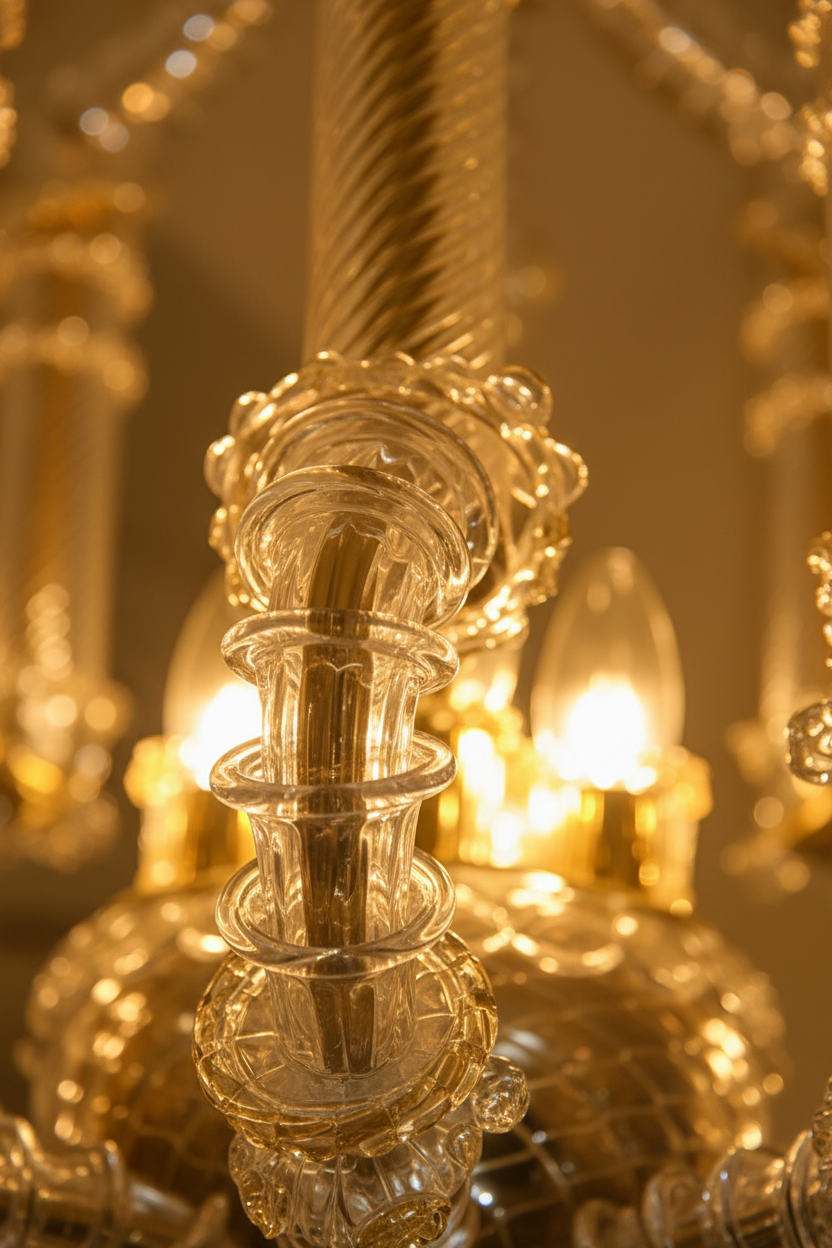
Bespoke design and custom decor: chandeliers, rugs, mirrors and wallpaper created for your project. From concept to finished piece, with Italian artisans.