Delivery: 7 to 10 business days
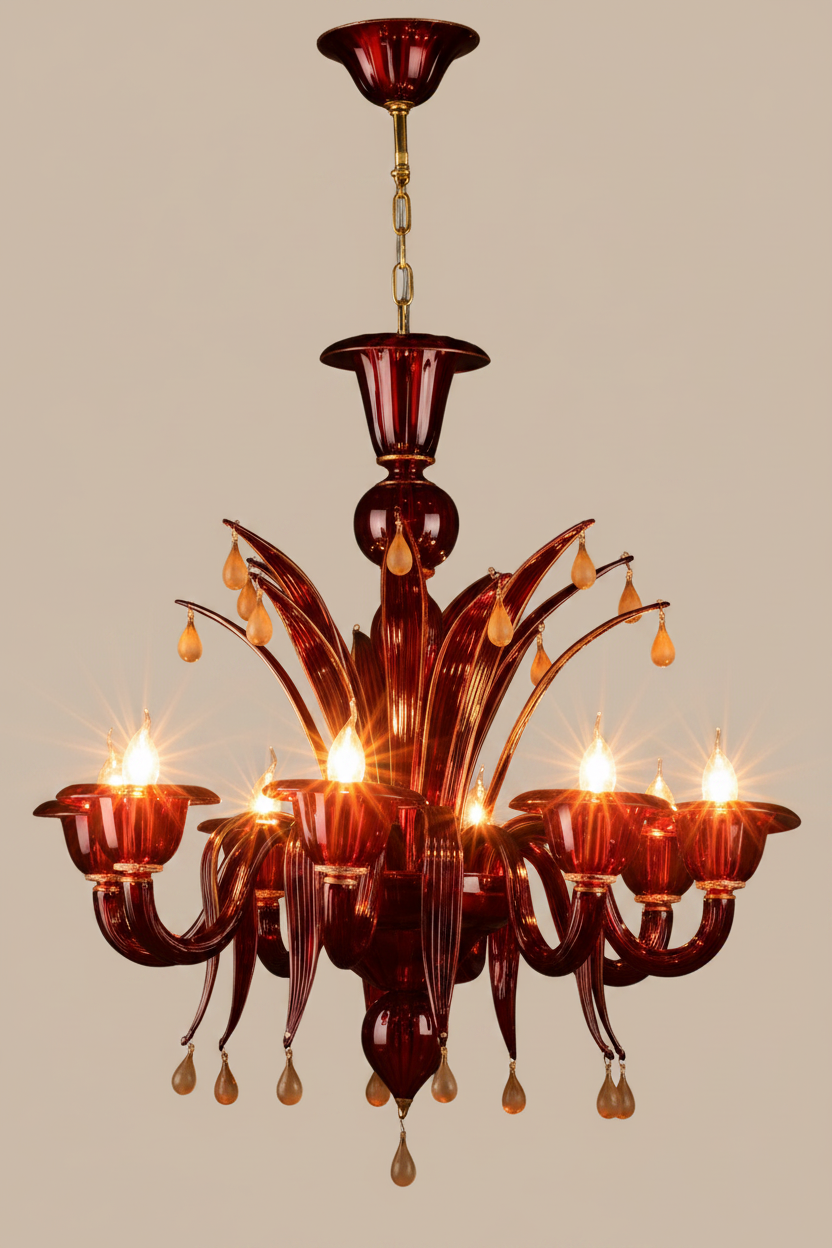
Pink alabaster Poliedri Murano glass chandelier, 32 hand-blown elements, brass and gold-tone frame. Carlo Scarpa-inspired design for refined luxury interiors.
-
Glass: Hand-blown Murano glass, faceted poliedri elements, pink alabaster finish; 32 elements total
-
Frame: Brass and gold-tone metal, multi-element pendant structure
- Dimention: Height with chain: 40¼ in (104 cm); Height without chain: 16¼ in (42 cm); Diameter: 13⅝ in (35 cm)
-
Glass element height: 5⅞ in (15 cm)
-
Glass element diameter: 2¾ in (7 cm)
-
Bulb fitting: 2 × E14 (not included)
This pink alabaster Poliedri Murano glass chandelier — 32 hand-blown elements, Italian-made, Carlo Scarpa-inspired — It does not overwhelm. It does not need to. It arrives in a room quietly and then refuses to be ignored — the way the best Italian design objects always have.
The craft
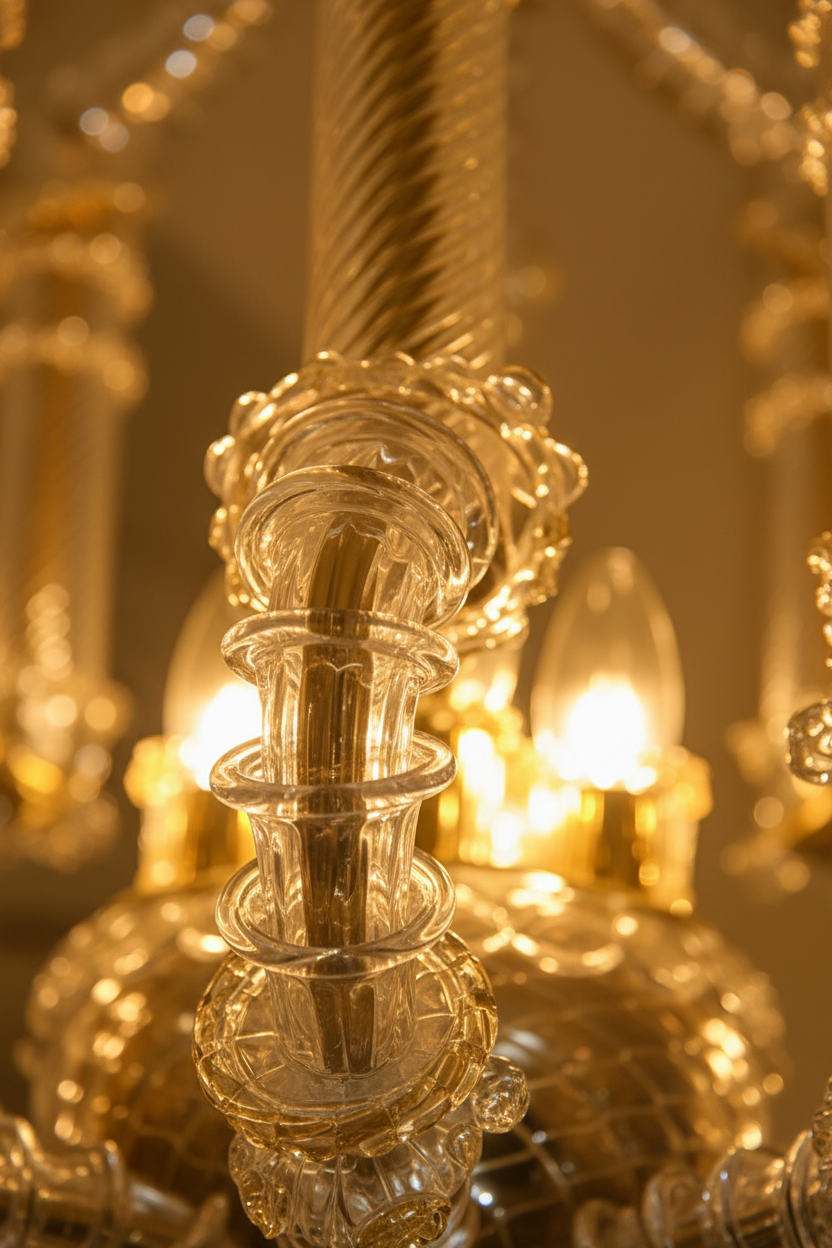
Each of the 32 poliedri elements is individually mouth-blown, using techniques that have remained essentially unchanged across generations of island glassmaking. The poliedri form — a precisely faceted glass body with geometric multi-faceted surfaces — carries one of the most distinguished lineages in twentieth-century Italian design. Its vocabulary is inseparable from the work of Carlo Scarpa, whose engagement with Murano glass at Venini in the 1930s and 1940s established a design language that continued to resonate through the late twentieth century and into the present. In pink alabaster, the poliedri facets acquire a softness that the harder, more transparent finishes do not have. The alabastro technique produces a glass that is semi-opaque — dense enough to diffuse light gently, translucent enough to let warmth pass through. The result is a glow rather than a beam: the kind of light that changes the quality of a room rather than simply brightening it.
The material and structure
The brass and gold-tone metal frame holds 32 elements in precise geometric arrangement, structured to distribute visual weight evenly across the full diameter of the piece. At 13½ inches across, the composition is contained — every element is visible, every facet legible, and nothing is lost in the density that characterizes the larger poliedri chandeliers. The gold-tone finish of the frame complements the blush of the alabaster glass with the particular warmth that only metal and hand-blown glass together can produce.
Style and spaces
The pink alabaster poliedri chandelier occupies a specific register in the vocabulary of Italian lighting: it is neither minimalist nor maximalist, neither purely historical nor aggressively contemporary. It sits at the intersection of those poles — which is exactly where the most enduring Italian design objects tend to live. In a bedroom or dressing room, it introduces a note of softness and luxury without competing with the rest of the scheme. In a dining room with a neutral palette, the blush tone becomes the warmest element in the space — a chromatic anchor that gives the room its mood. In a boutique hotel suite, it communicates something that no generic fitting can: that someone made a considered choice, and that the guest is the beneficiary of it. The two-bulb E14 configuration is intentionally intimate — this is a chandelier designed for rooms where mood matters more than raw output, and where the quality of light is more important than its quantity.
Dimensions
The chandelier hangs to 40¼ in (104 cm) including chain, or 16¼ in (42 cm) for the body alone. The composition measures 13⅝ in (35 cm) in diameter. Individual poliedri elements measure 5⅞ in (15 cm) in height and 2¾ in (7 cm) in diameter. The relatively slender diameter and moderate hanging length make this chandelier adaptable to a wider range of ceiling heights than the larger poliedri compositions — it reads well from 9 ft upward, and does not require an architectural statement space to perform. The E14 fitting is compatible with all standard low-consumption LED bulbs, with full flexibility on light temperature to suit the mood of the space.
Note: As with every hand-blown glass piece has slight variations in tone and surface texture between individual poliedri elements are not imperfections. They are the mark of the fornace — the evidence that no machine touched the glass, and that this chandelier, in this exact configuration of color and form, exists nowhere else in the world.